
By Greer Waller ’29
President Ronald Reagan’s aggressive expansion of executive power defined the 1980s as much as the Cold War standoff. On the surface, Reagan projected an era of renewed patriotism, economic deregulation, and foreign policy designed to roll back the influence of the Soviet Union. Yet, beneath this facade of optimism, American inner cities were descending into a nightmare of addiction, violence, and militarized policing driven by the explosion of crack cocaine. For decades, the Cold War standoff in Latin America and the crack epidemic in South Central Los Angeles were treated by historians and the media as separate and unrelated. One was geopolitics, the other was street crime. Mainstream narratives labeled any link between them a conspiracy theory. However, to understand the culpability of “Freeway” Rick Ross, one must dismantle this artificial separation. One must look beyond the individual to the system that facilitated his rise: a foreign policy willing to sacrifice the Constitution for gains and a domestic policy willing to sacrifice Black citizens to maintain social control.
As historian Joseph Ledford argues in his analysis of the era, the Reagan administration did not view the Iran-Contra affair as “foreign policy gone awry,” but rather as the “Reagan Doctrine fundamentally in action” (1). This doctrine pursued a rollback of Communism so absolute that it necessitated the privatization of war, effectively outsourcing national security to a network of shadow financiers, arms dealers, and drug traffickers. But this machinery required human fuel. Rick Ross became the engine for this illicit funding. When the machine broke down, the state attempted to bury him under a life sentence to hide its own guilt. The state wants to forget him, but history cannot allow it to do so.
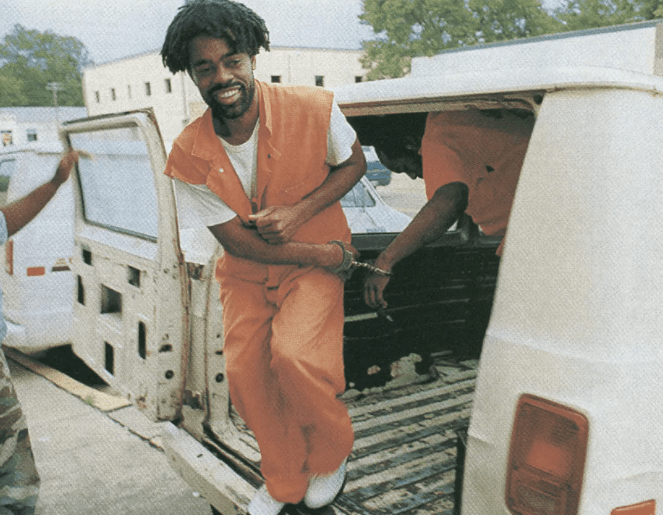
Rick Ross’s release in 1994.
To understand this machine, one must first understand the operator. The government’s narrative of Rick Ross paints him as a natural-born predator, a “super villain” who descended upon Los Angeles to destroy it. However, a close reading of his autobiography, Freeway Rick Ross: The Untold Autobiography, reveals a far more uncomfortable truth. Ross was not a deviation from the American system, but a product of it. Before he was a kingpin, he was a young man paralyzed by a shame that the public school system had helped him construct: he could not read. Ross describes his early life not as a criminal plot, but as a series of closed doors. He was a tennis prodigy who secured a scholarship to Long Beach State, viewing the sport as his legitimate ticket out of poverty. But when the exposure of his illiteracy revealed the failure of the teachers who had passed him along just to keep him on the court, the university revoked that ticket. In his own telling, that was the moment the covenant with society broke (2).
In the rapidly deindustrializing landscape of 1980s South Central LA, a Black man without a degree or the ability to read had no viable path to survival, let alone success. It is here that his voice shifts from that of a victim to that of a calculated entrepreneur. He describes his entry into the drug trade not as a moral failing, but as a pivot. When he saw his friend “San Jose” Mike paying for school expenses with drug money, Ross did not see a crime; he saw a way out. He wrote how the idea of what cocaine could do for him hooked him (3). This distinction is vital for the microhistorical view: Ross was addicted to the agency dealing drugs provided. For the first time, he was not the dumb kid in the back of the classroom; he was a businessman commanding respect and control.
This subjective reframing challenged the state’s vilification. In Ross’s eyes, he was functioning as a parody of the Reagan entrepreneur. He applied the very principles the President championed: deregulation, risk-taking, and supply-side economics, to the only commodity available to him. He details the specific logic of his business: competing with predatory pricing, expanding territory, and industrializing the product. When he eventually met Nicaraguan supplier Danilo Blandón, Ross saw a wholesaler offering a product at below-market rates. The politics of the war in Nicaragua were invisible to him. He was simply trying to scale his business, unaware that his business partner was using him to fund a foreign war.
Furthermore, Ross actively constructed a persona to reconcile his actions with his conscience, affectionately called “Robin Hood” by community members (4). He details how he used his drug profits to fund community needs that the state had abandoned. In his subjective view, he was stimulating his community, not poisoning it. He argues that he was filling the void left by Reagan’s measures. While Ross constructed this strategic misrepresentation designed to soften his image, it reveals a crucial truth about how he viewed himself: not as an enemy of the state, but as a provider for a community that the state had left to die. He internalized the logic of the streets, where the government was the distant oppressor, and the dealer was the local benefactor.
By giving weight to Ross’s voice, we expose the tragedy of his agency. He believed he was making independent choices to buy, sell, and expand, unaware that he was walking down a corridor the CIA had constructed. He thought he was building an empire, but he was merely staffing a fundraising operation for the National Security Council. The tragedy of Rick Ross’s autobiography is not just the crime. It is the illusion of control. He viewed himself as the author of his own destiny, rewriting the script of poverty that society handed to him. It was only decades later that he realized he had never been the author at all.
This paper argues that the War on Drugs and the Cold War were not distinct events, but a single, interconnected system. By utilizing the methodological framework of microhistory, as defined by Carlo Ginzburg, and the theories of power outlined by Philip Deloria and Alexander Olson, we can make visible the mechanisms of the state. We will demonstrate that Rick Ross was not a kingpin in the traditional sense, but a subject constructed by the state to serve two purposes: first, as a source of liquid capital for an illegal war, and second, as a scapegoat to justify the expansion of the carceral state. The government used Rick Ross to fund its foreign policy, and then it used the myth of Rick Ross to justify its domestic policy.
To understand the rise of “Freeway” Rick Ross, one must first understand the geopolitical volatility in Nicaragua. In 1979, the Sandinista National Liberation Front, a socialist political party named after revolutionary Augusto César Sandino, overthrew the US-backed Somoza family dynasty (5). Viewed through the administration’s “one-sided perspective of freedom versus the evil empire,” the Sandinistas were not merely a local government but a Soviet Cuban battlefield in the Western Hemisphere (6). The administration’s response was immediate destabilization. They threw their support behind the Contras, short for la contrarrevolución, a disjointed coalition of rebel groups seeking to overthrow the Sandinista government. However, this ideology collided with the legislative reality of the post-Vietnam era. A Congress wary of unchecked executive power utilized its “Power of the Purse” to halt the conflict. Between 1982 and 1984, Congress passed a series of legislative bills known as the Boland Amendments. Named after US Representative Edward Boland, these laws explicitly prohibited the Department of Defense and the Central Intelligence Agency (CIA) from spending funds to overthrow the government of Nicaragua (7).
Consequently, the passage of the Boland Amendments created a constitutional crisis. As Theodore Draper details in A Very Thin Line, the administration faced a choice: adhere to the law and abandon the Contras or evade the Constitution to maintain the operation (8). They chose the latter. The administration’s refusal to accept a congressional veto on foreign policy initiated a culture of lawlessness within the National Security Council (NSC). To bypass the treasury, the White House required a financing structure completely untraceable to the US government. This need created “The Enterprise,” a shadow financial network designed to operate entirely beyond the reach of federal oversight. To conduct this directive, the administration turned to Lieutenant Colonel Oliver North, an NSC staffer whose subsequent testimony identified him as the network’s operational center. North famously described the diversion of funds from illegal arms sales to Iran into the hands of the Contras as a “neat idea” (9). However, as Draper notes, characterizing this as merely a “neat idea minimized the gravity of the act; it was a systematic exploitation of Congress’s constitutional authority” (10). Driven by this determination to bypass oversight, the Enterprise decided to privatize foreign policy to generate the $48 million needed for an off-the-books war (11). This desperation created the market conditions that allowed a figure like Rick Ross to ascend from a local dealer to a figure of national consequence.
Methodologically, focusing on the specific trajectory of Rick Ross to understand the geopolitical sprawl of the Cold War requires a shift in the scale of observation, a technique central to the practice of microhistory. Critics might argue that focusing on a single drug dealer in Los Angeles is too narrow a lens to view the machines controlling America. However, as historian Carlo Ginzburg argues in his article, “Microhistory, Two or Three Things That I Know About It,” the purpose of reducing the scale of analysis is not simply to view a smaller subject, but to test the validity of “macrohistorical” paradigms through the lens of a specific life (12).
In the standard historical view, the Iran-Contra affair is a matter of congressional hearings, redacted memos, and executive orders. It is a history of great men: Reagan and Oliver North. However, Ginzburg warns against the assumption that the norm is the only source of historical truth. He argues that the anomalous case often reveals more than the norm because the anomaly contains the norm within it, while the reverse is not true (13). The anomaly forces the system to make its inner workings visible to contain or utilize it. Rick Ross is that anomaly. He was an illiterate college dropout who somehow managed to build up a multi-million-dollar drug empire.
By utilizing Ginzburg’s methodological approach, we can view Ross not merely as an anecdote but as the clue that reveals the hidden structure of the system (14). Ginzburg discusses an evidential paradigm, suggesting that small, seemingly trivial details can reveal the larger biological structure of society, much like a footprint reveals the animal. When we look at the history of the Cold War, we see the rhetoric of freedom. But when we reduce the scale of observation to the streets of LA, we can see the CIA’s assets flooding the streets with the very drugs the President was denouncing. Therefore, the microhistory of Rick Ross – what the state was doing – is the necessary corrective to the history of the Reagan era: what the state said it was doing.
A central tenet of the microhistorical method, as outlined by Ginzburg, is the reliance on “the trace” evidence left behind from those on the margins of power (15). However, in the case of the Iran-Contra affair, the scarcity of evidence was not accidental; it was manufactured. The Reagan Administration did not merely break the law; they launched an assault on the archive itself. In the days leading to the investigation, Lieutenant Colonel Oliver North and his secretary, Fawn Hall, famously engaged in a shredding party, destroying thousands of confidential memos and financial records (16). This act of destruction changes the nature of the historian’s task. As Deloria and Olson note in American Studies: A User’s Guide, the archive is usually viewed as a neutral source of truth, but it is often a tool of power that determines what counts as history (17). By shredding the documents, the State attempted to curate its own archive, removing the anomalous evidence of drug trafficking and leaving only the normative evidence of diplomacy. They sought to produce a sanitized history where the Contras were not freedom fighters, but drug runners.
Consequently, Rick Ross’s autobiography, Freeway Rick Ross, ceases to be merely a memoir; it becomes a counter-archive. In the absence of official government records, the oral history of the street becomes the primary record of the event. Ginzburg argues that the historian must often read “against the grain” of official documents to find the voices of the marginalized (18). Here, the dynamic inverts itself: the marginalized, Ross, provides the written record, while the State provides the silence. Ross’s meticulous detailing of his experiences serves as a reconstruction of the shredded archive. When he details the organization of his empire, he is not just recounting a crime. He is repairing the historical record that Oliver North attempted to delete.
It is in this desperate search for funding that the geopolitical narrative intersects with the criminal underworld described by Gary Webb in Dark Alliance: The CIA, the Contras, and the Crack Cocaine Explosion. To sustain the northern front of the war, the Contra leadership cultivated alliances with major traffickers such as Norwin Meneses and Danilo Blandón. These men functioned as established traffickers with the network capable of moving massive quantities of cocaine into the United States. Within this context, Webb’s analysis suggests that the CIA and the NSC were, at a minimum, willfully blind to the nature of their assets. By categorizing trafficker movements as national security operations, the US government allowed the political necessity of the Cold War to subsidize the commercial necessity of the drug trade. Proceeds from these operations funneled back into the revolution, establishing an ironic balance: the political destabilization of Nicaragua became financially contingent upon the social destabilization of American inner cities.
Crucially, this pipeline of politically protected cocaine required a domestic distributor capable of moving massive quantities of cocaine. Enter “Freeway” Rick Ross. In the grand scope of the Iran-Contra Affair, Ross is often viewed as a footnote, but structurally, he was the essential final link in the chain of “The Enterprise.” Without a domestic buyer like Ross, the cocaine smuggled by the Contras would have been worthless, and the funds for the war would have dried up. Functioning as that essential link, Ross, an ambitious dealer in South Central Los Angeles, utilized the cheap and abundant supply provided by Blandón to monopolize the crack cocaine market.
The catalyst that transformed Ross’s local operation into a national crisis lies in the economics of his relationship with Nicaraguan supplier Oscar Danilo Blandón. Ross confirmed that Blandón provided cocaine of unusual volume, cheapness, and purity, a market anomaly that defied standard criminal logic (20). Economically, the data support this collusion. In a market, prices remain high to account for risk and competition. However, Webb’s accounting reveals that Blandón sold to Ross at prices that undercut the competition by thousands of dollars per kilo. This low cost suggests a product protected from standard market risks; a government-subsidized commodity.
This is a classic case of dumping, a predatory economic strategy where a foreign entity sells a product below market value to destroy domestic competition. But in this case, the foreign entity was CIA-backed. Webb argues that the Contra network needed immediate funding for the war effort in Nicaragua, and Ross was the most efficient engine to convert product into cash. By pumping this cocaine into LA, the Contra supply chain artificially accelerated the crack epidemic. Blandón later admitted in court testimony that these profits funneled to the Contra revolution and the Nicaraguan Democratic Force (FDN), linking the destruction of Black neighborhoods to the Reagan Doctrine (21).
If the economics of the Dark Alliance explain how the crack epidemic happened, we must turn to an American Studies theory to understand why Rick Ross was forced to take the sole blame for it. Sociologically, this strategic withdrawal of resources, paired with the unchecked influx of the drug trade, mirrors Foucault’s idea of power and the making of the subject. As Deloria and Olson argue, power is not just the ability to use force: it is the ability to define reality (22). The Reagan administration faced a crisis: they needed to maintain public support for the massive expansion of police power to deal with the increasing War on Drugs. To win this consent, they could not fight an abstract concept; they needed a tangible villain. They needed to construct a subject that the American public could fear and use their power to produce categories of people that fit into the narrative of the state.
The state engaged in a dual process of subject formation. Oliver North was portrayed as a complex hero despite admitting to lying to Congress and shredding evidence. The narrative framed him as a man doing his best for his country, contextualizing his criminality. In contrast, the state constructed Rick Ross as the drug kingpin and super predator. These labels were not natural; they were cultural constructions. The media, working with law enforcement, stripped Ross of his context and reduced him to a simple evil. This process of labeling is an act of power. But Deloria and Olson take this further, arguing that cultural labeling is how the state creates the other (23). By labeling Ross a kingpin, the state effectively declared him an enemy. This allowed the public to accept the harsh, militarized policing of South-Central LA as a defensive war against foreign invaders. The kingpin label was the tool that justified the erasure of Rick Ross’s civil rights.
The construction of the kingpin was only one half of the equation; the other half was the construction of the victim. To justify the militarization of the police, the state needed to convince white, suburban America that the chaos of the inner city posed a threat to their way of life, achieved through the cultural production of fear (24). The media, acting as the amplifier for the state narratives, flooded the American consciousness with imagery of the “Crack Baby.” This term, debunked as an exaggeration of the long-term effects of prenatal cocaine exposure, serves a specific function. It stripped the Black family of its humanity and replaced it with a biological terror.
This rhetorical strategy allowed the state to bypass the usual checks and balances of democratic governance. By framing the drug war as a defense of innocent children, the Reagan administration was able to manufacture consent. The state often uses biopolitical threats, which are threats to the health of the species, to justify the suspension of the law. The crack epidemic was framed not as a public health crisis but as a war. Rick Ross became the face of this biopolitical threat, persecuted for selling an illegal substance and for waging biological warfare on the American future. This hyperbolic framing was essential: it was the only way to distract the public from the fact that the government’s own assets imported the biological weapon.
When the truth of this construction revealed itself, the state’s reaction was swift and brutal. This was most evident in the treatment of journalist Gary Webb. Dark Alliance, published in 1996, offered the evidence that Ginzburg describes, proof that the state was complicit in the drug trade. In a functioning democracy, this revelation should have toppled the government. Instead, the mainstream media, specifically the Los Angeles Times, New York Times, and Washington Post, launched an unprecedented attack on Webb. They functioned as the “immune system” of the state. Michel Foucault argues that power relies on disqualifying knowledge, keeping certain truths in the background so they cannot challenge the dominant order. Webb brought this knowledge into the light, and the institutions of power united to crush it, breaking down the minor details to discredit the larger truth.
Once the state had finished using Ross to fund its war and had destroyed Webb to protect its secret, it utilized the mechanics of biopower to discard the human evidence. The Anti-Drug Abuse Act of 1986 established the infamous 100:1 sentencing disparity. This policy mandated that possession of 5 grams of crack cocaine triggered the same five-year minimum sentence as 500 grams of powder cocaine (25). The result was a biopolitical weapon targeting a specific demographic: even though 2/3 of crack users were white or Hispanic, 82% of people convicted were Black (26).
These statistics represent what Deloria and Olson might call the structural enforcement of subjectivity: laws written to ensure that the Black crack dealers became permanent residents of the state. Despite the crime’s shared origins, a duality of justice emerged. Ross originally received a sentence of life imprisonment without the possibility of parole—a punishment designed to be terminal. In contrast, Oliver North saw his convictions reversed on appeal, and all his charges dropped. The prison system became the place for the disposable assets of the Cold War. Ross, given a life sentence, proved how biopolitical machinery was designed to consume him.
However, the state’s attempt to erase Ross has failed because he refused to remain silent. In his 2013 interview with the Brown Political Review, Ross argues that his entry into the trade was a functional response to a market void and systemic abandonment, rather than an innate moral failure (27). Rick Ross was released from prison in 2009 after his lengthy drug trafficking sentence was reduced because a court found that his original sentencing under the “three strikes rule” was an error. His resistance did not end with his release. It evolved into a commitment to repair the very community he once helped destabilize. While the state sought to bury him as a mere statistic of the War on Drugs, Ross utilized his time in prison to transform from an illiterate inmate into a scholar, eventually uncovering the legal precedents that secured his freedom. Since his release in 2009, he has defied the “kingpin” title by dedicating his life to mentorship and advocacy. By touring schools, promoting financial literacy, and speaking candidly about the traps of the illicit economy, Ross is actively dismantling the pipeline that the government helped construct. In doing so, he has reclaimed his agency, proving that while geopolitical schemes shaped his past, a genuine desire for atonement and community restoration defines his future.
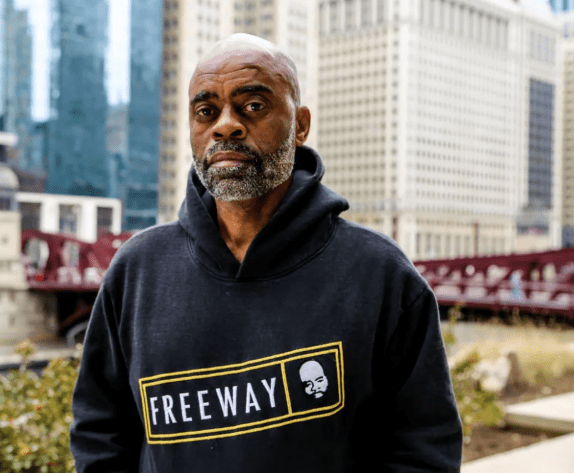
Rick Ross made an appearance at a social equity summit clinic in Chicago.
The connection between Ross and the NSC highlights the central thesis of culpability The government created the market conditions and the supply chain for the crack epidemic as a byproduct of foreign policy. The state wants to forget Rick Ross because remembering him forces them to confront their own reflection. He was not a deviation of the American system; he was its product. By applying the microhistorical lens, we see that the “Kingpin” was a fiction created to mask the architect. Rick Ross is guilty of drug trafficking, a fact he does not deny. But the “ultimate responsibility” for the sheer scale of the devastation lies with the architects of the supply chain, not just the manager of the storefront. Rick Ross argues that while he pulled the trigger, the government loaded the gun. By reading his story and refusing to accept the official label of monster, we engage in an act of civic resistance. We assert that the state cannot use human beings as fuel for its ideology and then discard them when they burn out. They want us to forget. We choose to remember.
Greer Waller is a finance major. Her essay was originally written for Professor Peter Cajka’s “American Microstudies” University Seminar.
References
- Webb, Gary. Dark Alliance: The CIA, the Contras, and the Crack Cocaine Explosion. New York: Old Street Publishing, 2015.
- Ross, Rick, and Cathy Scott. Freeway Rick Ross: The Untold Autobiography. Los Angeles: Freeway Studios, 2014.
- Ross and Scott, Freeway Rick Ross.
- Ross and Scott, Freeway Rick Ross.
- Knapp, Alyssa. “Nicaraguan Revolution (1978–1990).” “Burning with a Deadly Heat”: NewsHour Coverage of the Hot Wars of the Cold War, 2015. https://americanarchive.org/exhibits/newshour-cold-war/nicaragua.
- Webb, Dark Alliance.
- Draper, Theodore. A Very Thin Line: The Iran-Contra Affairs. New York: Simon & Schuster, 1992.
- Draper, A Very Thin Line.
- “Testimony of Lieutenant Colonel Oliver North.” CIA.gov, 1986. https://www.cia.gov/readingroom/docs/CIA-RDP90B01390R000300450005-3.pdf.
- Draper, A Very Thin Line.
- Engelberg, Stephen. “U.S. Aides Say Panama General Proposed Sabotage in Nicaragua.” The New York Times, November 19, 1987. https://www.nytimes.com/1987/11/19/world/iran-contra-report-us-aides-say-panama-general-proposed-sabotage-nicaragua.html.
- Ginzburg, Carlo, John Tedeschi, and Anne C. Tedeschi. “Microhistory: Two or Three Things That I Know About It.” Critical Inquiry 20 (1993): 10–35.
- Ross and Scott, Freeway Rick Ross.
- Ginzburg, Tedeschi, and Tedeschi, “Microhistory,” 10–35.
- Ibid.
- Ibid.
- Deloria, Philip Joseph, and Alexander I. Olson. American Studies: A User’s Guide. Oakland: University of California Press, 2017.
- Ginzburg, Tedeschi, and Tedeschi, “Microhistory,” 10–35.
- Webb, Dark Alliance.
- Knight, Henry A. “BPR Interview: Freeway Rick Ross.” Brown Political Review, 2014. https://brownpoliticalreview.org/bpr-interview-freeway-rick-ross/.
- “The CIA-Contra-Crack Cocaine Controversy: A Review of the Justice Department’s Investigations and Prosecutions.” Department of Justice Office of the Inspector General, 1997. https://oig.justice.gov/sites/default/files/archive/special/9712/ch01p1.htm.
- Deloria and Olson, American Studies: A User’s Guide.
- Deloria and Olson, American Studies: A User’s Guide.
- Deloria and Olson, American Studies: A User’s Guide.
- “U.S. Supreme Court Weighs 100-to-1 Disparity in Crack/Powder Cocaine Sentencing.” American Civil Liberties Union, October 1, 2007. https://www.aclu.org/press-releases/us-supreme-court-weighs-100-1-disparity-crackpowder-cocaine-sentencing.
- “The NAACP Supports the Complete Elimination of Racial Disparities Associated with Crack Cocaine Convictions.” NAACP, June 13, 2022. https://naacp.org/resources/naacp-supports-complete-elimination-racial-disparities-associated-crack-cocaine.
- Knight, “BPR Interview: Freeway Rick Ross.”

