
By Liam Cavanaugh ’29
In the 34 years of my life, in war and peace, I have been a loyal, law-abiding citizen of the United States. One week after this nation was attacked at Pearl Harbor in 1941, I enlisted as a private in the Army of the United States and served for more than four years…Upon my discharge I returned to my job as a newspaperman with the Detroit Times. I am a homeowner, taxpayer, and parent, father of two boys and a girl.
Introduction
This excerpt is the beginning of the statement of Elliott Maraniss in preparation for his hearing with the House Un-American Activities Committee (HUAC) on March 12, 1952, in Room 740 of the Federal Building in downtown Detroit. He never delivered the statement, as the head of the HUAC rejected the proposal to read it during the hearing. He refused to respond to any controversial questions during the hearing relating to his Communist Party affiliations, and the committee did not reach a verdict. His presumed guilt by the public caused Elliott to be fired from his newspaper job and uprooted his family from Detroit, putting their future into jeopardy.
Many questions about Elliott’s life arise from his dispute with the HUAC and his statement. How did he get here? Could the blacklisting be justified? Did any other journalists go through similar experiences? These questions served as the base for my research and helped me develop my understanding of Elliott. After conducting my research, I found that HUAC labeling Maraniss as un-American, despite being a law-abiding citizen and serving his country in World War II, shows how the government body associated Americanism solely with anti-communism. They used this definition of Americanism to target Elliott and other journalists in the 1950s, exploiting the newspaper industry’s Communist affiliation and their attempts to unionize.
I centered my research around Elliott through the text A Good American Family: The Red Scare and My Father, written by his son, David Maraniss. He presents his research on his father in the book, mixed with a few personal anecdotes, centering the story around his father’s trial with the HUAC. His goal of writing the book is twofold: to give a historical account of his father’s life and to argue for his father as a “Good American” despite being seen as un-American. He never explicitly defines the characteristics of a good American, but I think he does this purposefully to leave it up to the reader to decide what constitutes a good American.
My research will be presented through a microhistorical approach revolving around Elliott Maraniss. Microhistory is a relatively new method of historical research that uses a specific person or place to describe a larger historical trend. Whereas David Maraniss uses his book to make an argument centering around Elliott about how his family should be considered a good American family, I will use Elliott’s life to make my larger-scope argument about the House un-American Activities Committee, Americanism, and other journalists during the 1950s.
My primary element in making my microhistorical argument is by including and analyzing excerpts of Elliott’s Maraniss statement to the HUAC, which will be displayed in italics throughout the paper. The statement serves as a starting point for each small argument I am going to make, adding up to piece together my overall argument. Microhistorian Timothy Gilfoyle inspired me to structure my paper in this way through his book, A Pickpocket’s Tale. The story starts each chapter with the autobiography of pickpocket George Appo and expands on the words of Appo to make broader historical arguments (1). I will use the statement of Elliott Maraniss in a similar fashion.
Despite placing importance on the statement, I will also rely heavily on A Good American Family to explain Elliott’s life. This style is similar to Gilfoyle, as both of our works centered around the only extensive literature written on our historical figures. Because of the reliance on the book, it is important to consider how the construction of David’s book could affect the way I write my paper, especially with the father-son relationship.
David starts the book by saying: “think of this story like a wheel. The hearing in room 740 is where all of the spokes connect” (2). I believe that David structures the story this way to show how everything in his family from his father’s birth to David’s own childhood revolved around this one event. He wants to place importance on the hearing while laying out all of the details about Elliott surrounding it. This all ties back to my belief that David wants the reader to make the decision for themselves whether his father’s hearing and blacklisting could be justified. His ability to stay objective for most of the book, excluding the beginning and end, supports this claim that David does not want to cloud any of the details of Elliott’s life.
David’s rationale for an objective narrative connects to his lack of knowledge of his father’s experiences as a Communist and with the HUAC. He states that he wondered “whether by the end my father would be more of a stranger to me,” but “he emerged with a clearer appreciation of the contradictions and imperfections of the American story-and with a better understanding of my father” (3). Throughout the book, it seems that David wants to discover information about his father along with the reader. The discoveries in his research are both new to him and the reader, so both parties can come up with conclusions about his father on their own. Because of his objective take, I feel that I can accurately convey information about Elliott without it being skewed by David. It is important to note that any personal information has the possibility to contain some personal bias, as any opinion piece of literature does.
The author, Elliott Maraniss, and the book, A Good American Family, are both incredibly complex. However, I believe that the complexity only adds to the intrigue and importance of Elliott’s story. After spending extensive time with Elliott, I found myself enamored with his character despite also feeling distant due to the barrier created by David writing the story. I hope to bridge as much of the gap between the reader and Elliott as possible through extensive use of his statement, so you too as the reader will find yourself interested in the life of Elliott Maraniss. Whether you agree or disagree with his political views, statements, or actions, I hope that you will be able to see just how important Elliott’s life is in understanding what it means to be an American.
I
I don’t like to talk about personal things. But my Americanism has been questioned and to properly measure a man’s Americanism you must know the whole pattern of a life.
Elliott Maraniss was born in 1918 in Boston, Massachusetts, but spent his childhood in Brooklyn (4). Ironically, his favorite activity could be argued to be the most American hobby of all: baseball. He grew up playing the sport and was skilled enough in high school to attempt to play at the University of Michigan in 1935. Interestingly, he never played for the team as he found himself more interested in journalism and politics once on campus (5). This interest led him to be involved with The Michigan Daily, a student-led newspaper for the University. The Daily, described as a “communist newspaper” by some of its members, featured a community of progressive thinkers that helped establish worker rights in Michigan and contained members who fought for the Abraham Lincoln Brigade in Spain (6). Maraniss found himself greatly intrigued by this group, but his involvement did not become serious until the spring semester of his sophomore year, where he took on increased responsibility as the lead night editor of the newspaper (7). Around this time, Elliott’s political views began to change, as he started to gradually become more interested in Communism.
American ideals were always at the core of Elliott Maraniss’ beliefs, but the injustices of the twentieth century caused him to search for a solution. Surrounded by communist students at The Daily and progressive teachers that he had taken an interest in, Elliott found himself looking at the world differently (8). David Maraniss does not expand extensively on what Elliott’s political ideals entailed, but only that he belonged to the Communist Party and participated in communist thought. However, this might be on purpose as David seems to not be sure of his father’s political beliefs, as he explained, “there was a story in the Daily in March 1938 that left me wondering what he was thinking. It was an Associated Press dispatch from Moscow reporting on the summation of a show trial in the Soviet Union, a chilling demonstration of one of the many ways Stalin ruled as a lethal despot” (9). Although he tried “to look beyond my own biases and be open to evidence that contradicted my assumptions,” it is evident that David had a difficult time wrestling with his father’s participation in a paper that aligned with what they viewed as the positive aspects of Soviet Communism (10). He also later explains later in the book that “why it took my parents so long to reject the false promise of communism is a question my siblings and I have thought about but can only offer theories for” (11). The use of the “false promise of communism” combined with the sentiment towards The Daily article clearly lays out David having trouble understanding his father’s time as a Communist. However, he is definitive that Elliott was a Communist during the 1930s, even if he does not expand on it.
The New Deal marked a significant turning point in radicalization for not only Elliott, but also the newspaper industry. The shift in the industry had its roots all the way in the 1910 to 1930s, as an increase in competition from radio and a decline in advertising forced newspaper companies to cut wages for its employees in an attempt to turn a profit (12). Many companies were still unsuccessful in this effort, as more than a thousand newspapers went out of business in this time period (13). In turn, less jobs were available for journalists, and the few available jobs came with brutal working conditions and frequent pay cuts. Although many years later, it is possible that Elliott felt these effects as he had difficulty finding a job after graduation and had to pull some strings to get a temporary job at The New York Post from 1940 to 1941 before settling down at The Detroit Times.
The lack of unionization among journalists in the 1930s exacerbated many of the poor conditions they faced. Thousands of employees had been let off in the Great Depression, and more than 3,000 had been let off in 1931 alone with the closing of The New York World (14). Although there was promise after the Depression, as the New Deal encouraged guilds to be formed, newspaper publishers pushed to exclude unions from their industry. Journalists began to unionize privately over their shared issues to collaborate over how to better their working conditions (15). They called for a forty-hour work week, with a $30 minimum salary for the five days of work (16). Despite their efforts, in 1933, the Roosevelt administration decided to cave into the pressures of publishers and instituted a wage-and-hours plan for the industry at their request (17).
After the blow dealt in the New Deal, journalists responded by officially organizing to try to better their working conditions. On December 15, 1933, members from forty-five journalist groups formed the American Newspaper Guild in Washington D.C. (18). Elliott, although not even in college at this point, would join the Newspaper Guild years later in 1941. By the time he was a member, the guild enjoyed a reputation as a strongly Communist organization.
The Newspaper Guild’s Communist link first started after the organization affiliated with the Congress of Industrial Organizations (CIO) in 1937 (19). Members of the Communist Party had heavy influence in the CIO, and therefore became heavily involved in the Newspaper Guild after the affiliation (20). Although many original members of the guild were not Communists, they could tolerate the discrepancy in political beliefs due to the progress made by the Communist members to further their rights. From June 1937 to June 1938, the guild won forty-seven contracts spanning eighty-seven newspapers, including the New York News, Boston Globe, and New York-World Telegram (21).
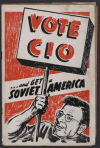
However, the positive changes made for journalists’ rights were not without drawbacks, as many anti-communists scrutinized the guild for being a communist-inspired organization. Even though membership in the Communist Party dropped significantly, 100,000 to less than 50,000, after the Nazi Soviet Non-Aggression Pact in 1939, the radicalism and communist affiliation of the Newspaper Guild had lasting effects (22). As shown in text in the photo below, “vote CIO and get a Soviet America,” the public closely tied the CIO with communism. By the time the Cold War and the wave of the Red Scare engulfed America, the communist label was extrapolated to the entire newspaper industry, causing a major issue for journalists such as Elliott Maraniss and their right to free speech.
II
I have been blacklisted in the newspaper business after 12 years in which my competency and objectivity have never once been questioned…But I would rather have my children miss a meal or two now than have them grow up in the gruesome, fear-ridden future for America projected by the members of the House Committee on Un-American Activities.
Just like for many Americans, December 7, 1941, changed the course of Elliott’s life. He faced a difficult decision after the bombing of Pearl Harbor, and after taking two weeks to contemplate whether to enlist, Maraniss decided to leave behind his wife and job at the Detroit Times and join the army (23). He soon found himself stationed in Trinidad and assigned to operations at an air base (24). He aspired to be an officer in the Signal Corps, and even had filled out an application for Officers Candidate School (25). Despite his enthusiastic spirit, his role in the war would be limited by a background investigation.
The Military Intelligence Division of the War Department flagged Elliott as a potential threat when he enlisted in the army (26). They investigated by researching his college information, employment, and political motivations. Their interviews with college friends and co-workers contained many discrepancies over Elliott’s character due to his communist roots making him an extremely polarizing figure. A peer at the Michigan Daily said that he was an “amiable fellow, easy to get along with and not the hot-tempered type. He was honest and above-board, and never made any derogatory remarks against this government” (27). In contrast, a supervisor at the Daily had all negative, distinct recollections of Elliott, saying that he was “pending out helping Russia” and was “always interested in radical things such as labor, strikes, etc.” (28). The discrepancies go on and on about his character. A colleague at the Times said that he “possessed no communistic tendencies, never made any remarks about this government, and could be classified as 100% American”, whereas another colleague remarked that “he strongly supported the Russian invasion of Finland and never deviated one iota from the Communist Party line in his ideas and principles” (29).
After conducting interviews with potential character witnesses, the Intelligence Division concluded that Elliott was “communistic” and “MARANISS should not be given employment in confidential work in the U.S. Army, but that he should be watched to determine the extent of his activities at the present time” (30). As a result, Elliott was then assigned to multiple different stations in the US during the war doing low-level tasks such as a bakery and athletic officer, until he spent the final two years of the war as a commander of a salvage and repair unit in Camp Lee, Virginia (31).
The power of the Military Intelligence Division over his life increased greatly when they sent his file to the FBI in 1943. As soon as Maraniss arrived back home in Ann Arbor in May of 1945, the FBI monitored him closely. Fifteen special agents would watch his every move for the next six years, keeping track of addresses, license plates, offices, signatures, and more (32). They knew of his visit to the Michigan Communist Party May Day Celebration in 1945, his attendance at the launching of the Michigan Herald, a leftist newspaper, in 1947, and his active participation in the Newspaper Guild. The Detroit Field Office of the FBI spoke with thirty-nine confidential informants and the Detroit police to gather evidence (33). His 1951 file read: “Character of Case: Security Matter-C,” with the C being short for communist (34).
His close surveillance and perceived threat depicted a much larger security issue for the United States at the time. The Soviet Union began recruiting Americans to become spies and reveal sensitive information as early as the 1930s and 40s. Previous estimations by historians John Earl Haynes, Harvey Klehr, and Alexander Vassilev stated that over five hundred Americans were flipped as communist informants, but new information in the VENONA decrypts, transcriptions of communication between KGB leaders in the US, suggest more gave information to the USSR (35). The largest potential threat of these spies lied in the scientists and technicians working on the Manhattan Project. The possible damage that could have been inflicted by these communist informants shows the real threat that spies presented for the national security of the country. It is within this context that it makes it a little more comprehensible as to why the FBI went to such great lengths to build a case file on Elliott Maraniss, but there still leaves some questions to be asked. Elliott appeared to be nothing more than a mid-level copywriter interested in radical political thought that posed no tangible threat to the safety of the United States. How could it be possible that the government went to the lengths to subpoena and try him in front of the House Un-American Activities Committee?
III
I feel that nobody has the right to question my Americanism-least of all a committee which itself has been called subversive, un-American and anti-labor by the CIO, of which I am a member, by President Roosevelt and by responsible organizations representing millions of Americans.
Elliott disputes the HUAC’s understanding of Americanism in his statement by pointing to his service in World War II and the normal life he has lived as a “homeowner, taxpayer, and parent, father of two boys and a girl.” Is this what Americanism is? Being a model citizen that does not oppose the state? Can you quantify Americanism? Can you be an American without possessing the trait of Americanism? What even is Americanism? All of these questions point to my opinion that Americanism is a deeply challenging and confusing topic to understand. The complexity only deepens when you analyze how the HUAC dealt with Americanism.
Per the Merriam-Webster dictionary, Americanism is the “attachment or allegiance to the traditions, interest, or ideals of the US” (36). On the other hand, the HUAC never had a concrete definition of Americanism or what it meant to be Un-American. From the Annual Report of the Committee on Un-American Activities for 1952, the year of Elliott’s hearing, the best classification of enemies of the state were individuals that participated in “subversive activities” and were “under the domination of communism” (37). Elliott fits into these two categories of Americanism in two different ways. He clearly has allegiance to the US by putting his life on the line for the country, but he also could be opposing the ideals of the US by opposing capitalism and joining communist groups. These attributes, I would argue, show how Elliott fits into the Merriam-Webster definition of Americanism in a complicated way.
However, if you analyze Elliott’s life in terms of the HUAC’s view of Americanism, it is evident that he falls into their definition of un-American by his participation in the Communist Party. We can only imagine the feelings of hopelessness that Elliott Maraniss had while walking into his hearing with the HUAC on March 12, 1952. What could he even be fighting for at this point besides to prove a point? The loss of his job after being subpoenaed already presumed his guilt as a Communist. He faced a committee of politicians that devoted their lives to outing Communists, and rarely ever ruled someone as not a Communist during a hearing. Maybe Elliott felt regret for being a Communist. Maybe he wished he could take it all back. Maybe he felt that he did nothing wrong and wanted to disprove the claims made by the committee. The unfortunate truth is that we will never know, as there is a gap in the book between when Elliott got his subpoena and the day of his trial. It is unclear if David chooses to exclude information or does not have any records from this time period, because the story goes from a “man in a dark suit” delivering Elliott’s subpoena straight to March 12, 1952 where “the weather in Detroit was clear and dry, with a high sky” (38). This structure is synonymous with his description of the story as a wheel, with the hearing at the center of it. Although it leaves out important details over Elliott’s life, it rightly adds to the significance of this day in 1952, as it would be the most important day in the Maraniss household for years to come.
IV
A witness has no rights whatever. He is denied the elementary due processes of law. He has no opportunity to confront his accuser, to cross examine witnesses, to call witnesses in his own behalf or even to make a statement. The committee is so poisoned with bigotry and malice that it is hard indeed to believe that it is indeed a committee of the Congress of the United States.
March 12, 1952. The day that the House Committee on Un-American Activities called Elliott Maraniss fifth to last amidst their final day of hearings in Detroit.
“Mr. Tavenner: Have you at any time been a member of the professional section of the Communist Party of Detroit?
Mr. Maraniss: I involve my privilege under the Fifth Amendment and refuse to answer… I wish however to make a statement about my views on un-American activities, if the counsel and Mr. Wood would permit.
Mr. Wood: After you answer the questions. If you answer them, we will be glad to have your explanation of anything you want to make, after you answer the questions.
Mr. Maraniss: Isn’t the purpose of this inquiry to discover the thinking of people on what constitutes un-American activities, and what activities
Wood: The purpose of this investigation is to determine what your position is with reference to membership in the Communist Party…
Mr. Maraniss: I rely upon my constitutional privileges under the Fifth Amendment and refuse to answer that question…
Mr. Maraniss: May I read the statement now Mr. Wood?
Mr. Wood: We don’t permit statements” (39).
Much of the hearing followed a similar back and forth manner to the excerpt, with Elliott invoking his fifth amendment to dodge any tricky questions. It is clear that the HUAC focused on Elliott’s communist affiliation through the repeated questions asked about his membership in the party. It is also evident how Elliott could argue that a “witness has no rights whatever” by the lack of explanation of his side of the story that the committee allowed. It is interesting to note that Elliott mentioned the term un-American multiple times during the hearing, whereas no one on the committee made any mention of the term. How could this be? A committee centered around “un-American Activities” does not establish what constitutes un-American activities? Elliott tried to make this connection during the hearing, but Mr. Wood cut him off immediately. I believe that this development is far from unintentional and that the committee, especially Wood, wanted to avoid the term completely. A closer look at the committee reveals secrets that raise questions about their validity to be deeming others un-American.
On the day of Elliott’s hearing, protesters lined the outside the government building with signs that pointed to the un-Americanism of the un-American committee. The largest banner in the protest, held by Arthur McPhaul, the executive director of the Michigan Civil Rights congress, read “the glorious history of the un-American committee”:
1st chairman Martin Dies-Texas poll taxer
2nd chairman John Rankin-Mississippi poll taxer
3rd chairman J. Parnel Thomas-convicted New Jersey embezzler
4th chairman John Wood-Georgia Dixiecrat” (40)
Although the sign would seem to most people to likely dramatize the issues of the chairman in order to discredit their qualifications for the job, if anything it undersold the problems of the chairmen. The first chairman, Martin Dies, who served when many referred to it as the “Dies Committee,” supported the poll tax and other racist laws (41). He refused to investigate the Ku Klux Klan (KKK) in detail, evidenced by only one percent of his 1940 report on un-American being devoted to the organization and calling the KKK “an old American institution” (42). John Rankin also supported the poll tax, publicly used derogatory language and slurs towards minorities, and praised the KKK (43). J. Parnell Thomas, the successor to Rankin, committed salary fraud and received kickbacks as the chairman which landed him in jail for eighteen months (44). Then came the man who interrogated Elliott Maraniss, John Wood.
John Stephens Wood served as the fourth chairman of the committee, and a closer look at his life raises plenty of questions over his qualifications for the position. Born and raised in rural Georgia, Wood aspired to be a successful lawyer and learned under Newt Morris, a north Georgian judge (45). The two became further linked after the murder of Mary Phagan in 1913, a young, white Atlantan. The man convicted turned out to be her boss, Leo Frank, a middle-aged Jewish superintendent (46). Many historians agree that Leo rightfully was acquitted after countless appeals, but many Georgians were passionately convinced of his guilt (47).
A mob hatched a plan to break into the prison that held Frank and lynch him. On August 16, 1915, the mob kidnapped Frank and lynched him 120 miles away, with Wood and Morris present after the execution only after hearing about the tragedy (48). After this, Morris and Wood took the body of Frank in their car and drove him to Atlanta for a proper burial in a noble act (49). Or so they claimed. A bible later discovered with a list of the lynching plotters named Newt Morris as the mastermind behind the operation (50). His right-hand man, John Wood, drove him everywhere during the event and willingly participated in the lynching of an innocent man. The burial purely served as a political stunt and alibi for Wood and Morris.
Just a year later, Wood attended an initiation meeting for the Ku Klux Klan (51). Wood claimed he quit after this one meeting, but the only official record that remains is the fifteen-dollar check that he wrote out to the organization. He climbed the political ladder from 1930 onward, eventually finding himself as chairman of the HUAC by 1945. The power Wood assumed as chairman is clear in his statement on the 1952 HUAC report, where he remarked, “I can proudly state that the representation on this committee has not been bipartisan, but rather nonpartisan. It has been Americanism against un-Americanism” (52). The hypocrisy of Wood is evident in his statement, which is rooted in a flawed definition of Americanism promoted by the threat of Communism. Instead of looking at Americanism as a complex puzzle that considered all parts of one’s identity, the HUAC only placed importance on a person’s affiliation with communism. This issue allowed for Wood, Dies, Rankin, and Thomas to dictate the lives of other Americans, when in fact, they could hardly be considered perfect Americans.
David wrestled with the struggle between Wood and his father through a rare personal anecdote, explaining, “in the forgiving spirit of my father, I’d like to give Wood the benefit of the doubt. There are no records, the people are all dead, the truth hard to discern…but he would maintain a cover story to conceal his aiding-and-abetting role with Judge Newt in the lynching of Leo Frank” (53). The ability for David to stay unbiased towards a man that caused his family harm gives further evidence for him wanting to lay out the facts to the reader in order for them to formulate their own opinion on the story.
V
Every newspaperman knows that history is not a printed page. It is the passion and striving, the struggling and endurance of men and women. These qualities that went into the making of our nation can be discarded only at great peril to ourselves and our children…right down to the present, newspapermen have zealously defended the freedom of the press.
I think it is important to take a step back from the madness that surrounds the hearing of Elliott and to investigate how he ended up in a courtroom with a government committee. Yes, obviously the hearing had a lot to do with being a member of the Communist Party, but why did Elliott concern the government in the first place? Why did Elliott make a large deal about the rights of newspapermen and their history of defending the press in his statement? The answer to these large questions lies in the complex relationship between communism, organized labor, newspapermen, and the House un-American Activities Committee.
In 1947, the government released the Attorney General’s List of Subversive Organizations, among them two groups relating to journalists, the League of American Writers and the Congress of American Revolutionary Writers (54). Although Elliott belonged to the Congress of Industrial Organizations, as mentioned earlier in the paper, the HUAC scrutinized all labor unions (55). They saw labor unions among colleges and the film industry as the largest threats for communist infiltration (56). In the 1952 HUAC report, they laid out the issue with unions, “the committee’s investigations into communism in vital defense areas were centralized in the past year in the areas of Detroit, Chicago, and Philadelphia.. The committee was shocked to find domination of some unions and locals by the Communist conspiracy” (57). Although the committee claimed to be shocked by the union-communist link, they had been investigating and targeting unions for years (58). They knew to start their search for potential communists in unions and guilds within these cities, because of the perceived perception of unionizing as an “un-American” or communist tendency. This link has been evident since the New Deal with communists being heavily involved in one of the largest labor unions, the CIO.
Journalists posed as one of the most straightforward targets for the HUAC due to the Newspaper Guild’s affiliation with the CIO and their public influence (59). It is easy to see how the HUAC saw journalists as a potential threat due to their authority over the press. If journalists belonged to the Communist Party, they had the ability to write pieces for the public that could contain favorable messages towards communism. Although I did not find any instances of this in my research, both in A Good American Father and in large newspapers during the era, it is possible that some journalists wrote stories in favor of communism or with communist influence. The HUAC’s concern with public influence also arose in the film industry, evidenced by the famous Hollywood Ten hearings in 1947 (60).
Because of the potential threat on public influence and the Newspaper Guild, the lives of Elliott and other journalists changed forever. From Elliott’s hearing in 1952 to 1957, the HUAC and other investigative committees subpoenaed more than one hundred journalists (61). There are only four recorded instances of journalists keeping their job after protesting their communist affiliations in HUAC hearings, specifically three employees at The New York Times and one at the San Francisco Chronicle (62). For the fired journalists, many never worked in the newspaper industry again (63). Many papers saw hiring these writers as simply too much bad publicity compared to the gain they would receive from their journalism skills (64).
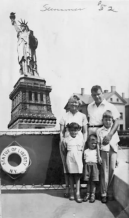
Elliott luckily found himself as one of the few to avoid many of the lasting hardships faced by subpoenaed journalists. He did still experience a lift-shifting change and many difficulties after his hearing. After being fired from The Detroit Times, his family moved to New York City where Elliott worked at the Daily Compass, a new morning tabloid paper (65). Below is a photo of the Maraniss family after their move to New York in front of the Statue of Liberty. David boldly states that “no photo could have more levels of meaning for our family. The Statue of Liberty is an American totem that my parents deeply believed in even now that they had been identified by a congressional committee as un-American more than ever” (66). The contrast between Americanism and un-Americanism that David highlights is startling. The courage and forgiveness that Elliott needed to have towards America after being treated so poorly by the government is truly remarkable. I believe that this perseverance shows that above all, Elliott truly valued being an American despite his issues with certain aspects of the country.
The Daily Compass ended up collapsing in the same year that the Maraniss family moved to New York, and as a result, they moved back to Michigan (67). Elliott would scramble around trying to find a job for the next five years and only found employment for one of those years at the Plain Dealer in Cleveland. Despite the difficulties, he relocated his family to Ann Arbor with his wife’s parents to make sure they had a stable life (68). In 1956, the family moved to Bettendorf, Iowa, where Elliott worked as an editor at Quant City Labor’s Daily for only a year (69). From 1967 until his retirement, the Capital Times in Madison, Wisconsin, employed Elliott where he had an impactful career on the paper (70). The Capital Times had been a challenger of Joseph McCarthy and the HUAC during the Red Scare and promoted free speech for their journalists (71). The paper could not have been a more perfect fit for Elliott, and David affirms this argument. He explains, “when my father, in his unread statement to the HUAC in 1952, wrote about the importance of a press that was defiant and free, he could not know at the time that a model of what he had in mind was the paper that would hire him five years later” (72). Elliott finally found himself at a paper that “zealously defended the freedom of the press,” as he said in his statement. The confines that the HUAC placed on the newspaper industry could not reach Elliott at the Capital Times. It was in this safety that allowed for Elliott and his wife to raise their children in the same city for the rest of their childhood.
Conclusion
This committee reflects no credit on American institutions or ideals. Its attempt to enforce conformity of political or economic thought is a long step towards dictatorship that holds the greatest danger to the American people. In this country we have never acquiesced in the proposition that persons should be punished for their beliefs.
Americanism is a term that will be relevant as long as the United States is relevant. Time and time again throughout the country’s history, the term un-American has been thrown around too loosely. The definition of the word is constantly changing, and what is considered un-American will largely depend on the political climate surrounding the country as it did with the Cold War and communism.
As seen in the journalism industry, reducing someone down to a single label by calling them un-American is incredibly dangerous. When the HUAC defined un-Americanism as being “under the domination of communism,” they could dictate the lives of journalists and other citizens through their personal beliefs. However, as seen in the paper, to call a citizen un-American is inherently un-American in itself. The inconsistencies between Maraniss’ and Wood’s lives are a key example of how Americanism is a complex term that is impossible to define in just one way. What makes an individual American varies vastly from person to person, and it is impossible to reduce a person’s identity and nationality to a single label. I believe that Elliott does a wonderful job of defining what it truly means to be an American in his statement:
I was taught as a child and in school that the highest responsibility of citizenship is to defend the principles of the US Constitution and to do my part in securing for the American people the blessings of peace, economic well being, and freedom. I have tried to do just that just to the best of my ability…But my Americanism has been questioned and to properly measure a man’s Americanism you must know the whole pattern of a life.
Liam Cavanaugh is a finance major. His essay was originally written for Professor Peter Cajka’s “American Microstudies” University Seminar.
References
- Gilfoyle, Timothy. A Pickpocket’s Tale: The Underworld of Nineteenth-Century New York. New York: W.W. Norton, 2006.
- Maraniss, David. A Good American Family: The Red Scare and My Father. New York: Simon and Schuster, 2019, 70.
- Maraniss, A Good American Family, 11.
- Maraniss, A Good American Family, 6.
- Maraniss, A Good American Family, 82.
- Maraniss, A Good American Family, 104.
- Maraniss, A Good American Family, 130.
- Maraniss, A Good American Family, 131.
- Maraniss, A Good American Family, 131.
- Maraniss, A Good American Family, 131.
- Maraniss, A Good American Family, 359.
- Alwood, Edward. Dark Days in the Newsroom. Philadelphia: Temple University Press, 2007.
- Greenhouse, Steven. “More Secure Jobs, Bigger Paychecks.” Columbia Journalism Review, May 30, 2018. https://www.cjr.org/special_report/media-unions-history.php.
- Greenhouse, “More Secure Jobs, Bigger Paychecks.”
- Greenhouse, “More Secure Jobs, Bigger Paychecks.”
- Alwood, Dark Days in the Newsroom.
- Alwood, Dark Days in the Newsroom.
- Alwood, Dark Days in the Newsroom.
- Alwood, Dark Days in the Newsroom.
- Alwood, Dark Days in the Newsroom.
- Alwood, Dark Days in the Newsroom.
- Michaels, Jonathan. “McCarthyism: The Realities, Delusions and Politics Behind the 1950s Red Scare.”
- Maraniss, A Good American Family, 157.
- Maraniss, A Good American Family, 158.
- Maraniss, A Good American Family, 158.
- Maraniss, A Good American Family, 161.
- Maraniss, A Good American Family, 163.
- Maraniss, A Good American Family, 163.
- Maraniss, A Good American Family, 164.
- Maraniss, A Good American Family, 166-167.
- Maraniss, A Good American Family, 179.
- Maraniss, A Good American Family, 262.
- Maraniss, A Good American Family, 262.
- Maraniss, A Good American Family, 262.
- Schrecker, Ellen. Review of Soviet Espionage in America: An Oft-Told Tale, by John Earl Haynes, Harvey Klehr, Alexander Vassiliev, and Susan Jacoby. Reviews in American History 38, no. 2 (2010): 355–361.
- “Americanism Definition & Meaning.” Merriam-Webster. Accessed December 20, 2025. https://www.merriam-webster.com/dictionary/Americanism.
- U.S. House of Representatives. Annual Report of the Committee on Un-American Activities for the Year 1952. 82nd Cong., 2nd sess., H. Doc. 2516. 1952. https://www.govinfo.gov/content/pkg/SERIALSET-11578_00_00-227-2516-0000/pdf/SERIALSET-11578_00_00-227-2516-0000.pdf.
- Maraniss, A Good American Family, 279-280.
- Maraniss, A Good American Family, 280-287.
- Maraniss, A Good American Family, 40.
- Maraniss, A Good American Family, 40.
- Maraniss, A Good American Family, 40.
- Maraniss, A Good American Family, 40.
- Maraniss, A Good American Family, 40.
- Maraniss, A Good American Family, 44.
- Maraniss, A Good American Family, 45.
- Maraniss, A Good American Family, 45.
- Maraniss, A Good American Family, 49.
- Maraniss, A Good American Family, 49.
- Maraniss, A Good American Family, 51.
- Maraniss, A Good American Family, 53.
- U.S. House of Representatives. Annual Report of the Committee on Un-American Activities for the Year 1952. 82nd Cong., 2nd sess., H. Doc. 2516. 1952. https://www.govinfo.gov/content/pkg/SERIALSET-11578_00_00-227-2516-0000/pdf/SERIALSET-11578_00_00-227-2516-0000.pdf.
- Maraniss, A Good American Family, 53.
- “Groups Called Disloyal.” New York Times, December 5, 1947.
- Alwood, Dark Days in the Newsroom.
- Alwood, Dark Days in the Newsroom.
- U.S. House of Representatives. Annual Report of the Committee on Un-American Activities for the Year 1952. 82nd Cong., 2nd sess., H. Doc. 2516. 1952. https://www.govinfo.gov/content/pkg/SERIALSET-11578_00_00-227-2516-0000/pdf/SERIALSET-11578_00_00-227-2516-0000.pdf.
- Alwood, Dark Days in the Newsroom.
- Alwood, Dark Days in the Newsroom.
- Durant, David. “HUAC Goes to Hollywood, Part 1: The Forgotten Investigation of 1940.”
- Alwood, Dark Days in the Newsroom.
- Alwood, Dark Days in the Newsroom.
- Alwood, Dark Days in the Newsroom.
- Alwood, Dark Days in the Newsroom.
- Maraniss, A Good American Family, 351.
- Maraniss, A Good American Family, 304.
- Maraniss, A Good American Family, 351.
- Maraniss, A Good American Family, 351.
- Maraniss, A Good American Family, 351.
- Maraniss, A Good American Family, 351.
- Maraniss, A Good American Family, 336.
- Maraniss, A Good American Family, 348.

