
By Jane Kramer ’29
Dorothy Day was about as eccentric as a person could get. After fighting for years and years as a suffragist, getting thrown in jail multiple times, and starving herself for the cause, when she finally received the right to vote, she never cast a ballot. Yes, when it was unpopular for women to have this basic right, Day was in the trenches: campaigning, protesting, and seeking understanding, but as soon as the 19th Amendment passed, she vowed to never turn in a ballot herself. Similarly, while her father was conservative and distanced himself from any type of commitment to religion, Day herself was extremely liberal and very Catholic. When the role of a journalist was widely glamorized by the New York public and flaunted a lavish lifestyle, Day wrote about what it was like to live on only $5 a week. But instead of interviewing the impoverished from a distance, she tried it out herself, living far below her means even though she had no need.
Was Day fundamentally a pessimist? Did she approach every issue of life with this glass-half-full mentality? Why would she never pick a side and stay on it? Was she a Socialist, Communist, Democrat, Republican, liberal, conservative, anarchist, personalist, all of the above? And most importantly, how and why did Dorothy Day become one of the most well-known American Catholics of the twentieth-century when there were no major Catholic influences in her life as a child and young adult?
Childhood
“Whenever I felt the beauty of the world in song or story, in the material universe around me, or glimpsed it in human love, I wanted to cry out with joy. The Psalms were an outlet for this enthusiasm of joy or grief…I always felt this common unity of our humanity the longing of the human heart is for this communion. If only I could sing, I thought, I would shout before the Lord, and call upon the world to shout with me” (1).
It was certainly providential how Dorothy Day found her way to Catholicism. Growing up, religion appeared to her in the smallest of ways, each building a complete picture of what faith meant piece-by-piece. Through conversations with a Catholic housekeeper, Day asked questions about the Saints. By observing a friend’s mother kneeling, saying her prayers, she wondered what greater purpose could make a person so obedient, so sure about such an abstract concept. While Day pondered greatly about this unique and powerful Catholic religion, other forms of faith were not completely absent in her life. Although her family did not actively practice, Day was baptized Episcopalian when she was about thirteen years old. Day claims to have adopted a very active conscience at a young age and always questioned what was right and what was wrong. Her father also had strong opinions on things, but his were very different from his daughter’s. He was an aspiring writer who “hated the radical movement…[and] wanted to keep things as they were” (2). Her mother was less of a dominant figure in the family. She was very no-nonsense and cared about her children deeply, but her ideas did not have as much of an influence on Day’s as her father’s did.
Dorothy Day’s childhood seemed to be an enjoyable, safe, and an otherwise average middle-class white American life. But even at this young age, she sensed that “safe” was not enough. She recounts a particular experience on a lonely day where she drifted off into the woods to explore a nearby creek. Day was so pleased to be by herself, so enthralled by the “sunny afternoon, blissful enchanted hours until the sudden realization came over [her] that [she] was alone, that the world was vast and that there were evil forces therein” (3). In the moments before this realization hit, Day was free. She took joy in exploring, going out on her own, away from her family and away from the world. She was at peace. But being overwhelmed by fear, by expectations and unwritten rules of society claiming that “to be alone in her own thoughts was bad,” she became afraid, distanced, and ran back to the comfort and familiarity of home.
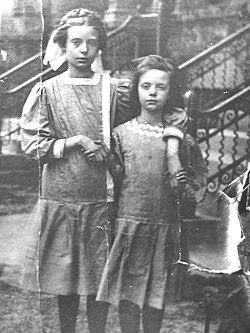
Day (left) and her younger sister Della outside the Episcopal Church they attended ~ 1910 (4).
With similar curiosity and delight, Day often ventured to Episcopalian and Catholic church services on her own to listen to the Psalms and readings which filled her soul with a new form of joy. These patterns Day developed at such a young age – her defiant nature, fascination by the beauty of life, and even hesitancy to fully commit to the deep desire of her heart – were well-established and affected the way she lived her whole life. For years, a constant battle would ensue between Day’s hopelessness when grappling with the unjust actions of society, corporations, and government and her great optimism that the good of humanity could eventually triumph.
Life in NYC
“I felt the spell of long loneliness descend on me. In all that great city of seven millions, I found no friends; I had no work; I was separated from my fellows. Silence in the midst of city noises oppressed me. My own silence, the feeling that I had no one to talk to overwhelmed me so that my very throat was constricted; my heart was heavy with unuttered thoughts; I wanted to weep my loneliness away. The poverty of New York was appallingly different from that of Chicago…And yet, as I walked these streets back in 1917 I wanted to go and live among these surroundings; in some mysterious way I felt that I would never be freed from this burden of loneliness and sorrow unless I did” (5).
In the summer of 1916, at the young age of 18, Day moved to New York City, motivated by her desire to create positive change in the world and struck by the prospect of a career in journalism in such a fascinating city. Once she arrived, however, Day was shocked and saddened by the normalized display of poverty; the “homeless and workless men lounging on street corners or sleeping in doorways in the broad sunlight appalled [her]” (6).
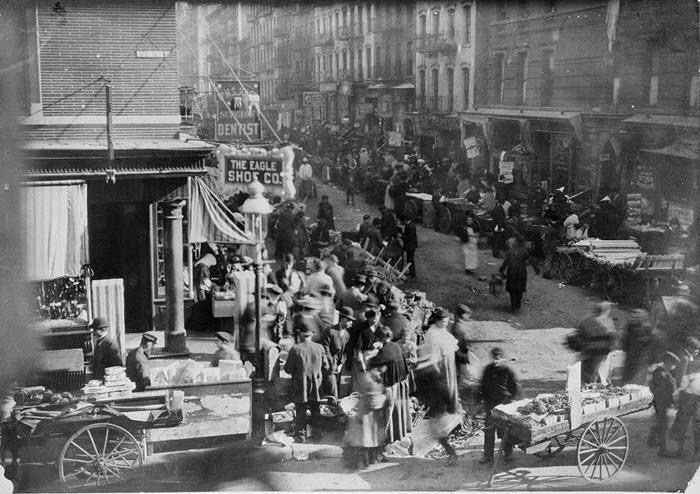
This image of New York City in 1915 represents the distinct city culture at the time: crowded streets, a combination of many age groups, and interactions between various social classes (7).
New York was an incredibly different city than Chicago, where Day had lived with her family for the past ten years. The poor and homeless, practically on display in the streets, filled her with unease and apprehension. To deepen her understanding of the issues New York was facing and attempt to find a solution, Day joined the staff of the socialist New York Call newspaper. However, Day soon came to realize that her dream profession wasn’t everything she had hoped for.
An article by Day, originally published in the November 21st edition of the New York Call, shared the darker realities of her life that were deemed “thrilling” and “romantic” by those around her. The story begins with a glimpse into that seemingly exhilarating atmosphere through the lens of her nightly routine: arriving at the office in the early evening, discovering groundbreaking stories by midnight, and ultimately crafting the perfect story by dawn. However, Day’s explanation of the journalism industry doesn’t end there. She makes a jarring shift to reflect on the more intimate side of her daily life. Day’s article reveals how witnessing and capitalizing on stories of horrors that real people experienced day after day affect her personally, “taking the curl out of [her] hair and spirit” (8). While the journalism industry often was, and still is, a place where a streamlined narrative which stretches the truth is crafted, Day’s article stands apart by speaking from the heart. Despite being trained to observe current events from an analytical perspective, Day’s empathetic nature prevented her from glazing over the harsh realities, and instead, allowed them to affect her very soul. By doing so, she not only personally reflected on how struggles of poverty and loneliness affected the human condition but also crafted many compelling articles to inspire the public to create change. Day’s willingness to share her deep and personal disgust with how struggling citizens were treated by the government and other powerful organizations so “dominated by ideas that they sacrificed to them countless millions of human beings” began her many challenges to authoritative systems (9). Through the collective efforts of those writing for the New York Call, Day hoped that these regular, personal stories of injustice and fear would enlighten New York society and inspire people to question the realities of their daily lives, searching under the surface for hidden biases ingrained in the system.
In addition to the investigations into the struggles of personal lives in New York City, the uprisings from the working class around the world helped Day grow in her awareness of the class divide. For example, by 1917, the Russian Revolution was in full swing. Due to prolonged warfare, severe famine and overcrowding, and growing disdain for the monarchy, the Bolsheviks sought to seize control of the Russian government (10). The same ideas and hardships that triggered the Russian Revolution were mirrored all around the globe. Particularly in New York City after the U.S. entered into WWI, many Americans, too, formed anti-government sentiments. The idea that successful revolution could occur in a completely different part of the globe proved that mere thoughts of “revolutionary striving…longing for liberty, human love, and justice” had amounted to a solid force that could change the world (11). Even though New York City was riddled with discrimination and injustice, once Day recognized how her personal core values created impact on a global scale, she found courage to fight for change in her own beloved community and beyond.
Reflecting on her time as a journalist, Day writes, “Life on a newspaper, whether radical or conservative, makes one lose all sense of perspective at the time. You are carried along in a world of events, writing, reporting, with no time at all for thought or reflection” (12). As Day describes in her autobiography, observing this normalized city life filled her with every emotion possible: disgust, anger, confusion, loneliness. However, any fears she had were overcome by her desire to create goodness in the world and passionate struggle to achieve freedom. Day strived to be a woman who was not merely a reporter, observing an injustice from an outside perspective, but in the midst of the action, actively creating change.
The Suffrage Movement
“It was as though one were in a zoo with the open bars leading into the corridor…The place was inadequately heated by one pipe which ran along a wall. Suspense and fear kept one cold…I lost all consciousness of any cause. I had no sense of being a radical, making protest against a government, carrying on a nonviolent revolution. I could only feel darkness and desolation all around me…I lost all feeling of my own identity. I reflected on the desolation of poverty, of destitution, of sickness and sin…I would never be free again, never free when I knew that behind bars all over the world there were women and men, young girls and boys, suffering constraint, punishment, isolation, and hardship for crimes of which all of us were guilty” (13).
On the night of November 14, 1917, thirty-one suffragist prisoners were aggressively taken from the district jail where they were each serving time to the much more brutal Occoquan Workhouse. There, the women were forced to wear prison clothing, subject to harsh labor, and suffered punishments like being chained to bars and sent to silent rooms for days on end (14). In a surprising change of events, many days later, on the 23rd of November, after discovering the judge of the case had violated a court order, the women went to court to be granted freedom. As a writer for The Suffragette noted: “The appearance of the women as they filed into the court was touching in the extreme. Some of them could hardly walk and were supported by the stronger women…Several lay back like ghosts in their chairs, hardly conscious of what the procedure that was to free them meant” (15).
One of these women was Dorothy Day, who had only recently joined the suffragist cause. While the protesting that Day and the other women participated in remained peaceful and was a much lower-stakes crime than that of murder, violence, or even theft, the suffragists were prosecuted just as brutally by the government. A series of suffrage protests in Washington, D.C. culminated in this soon to be known “Night of Terror.” Because of the aggressive and illegal sentencing, many major news outlets covered the event, not only suffragist-based newspapers, but even The New York Times. A year later, President Woodrow Wilson publicly stated his support for the suffrage movement. Due to the women’s courage, opinions began to develop and change.
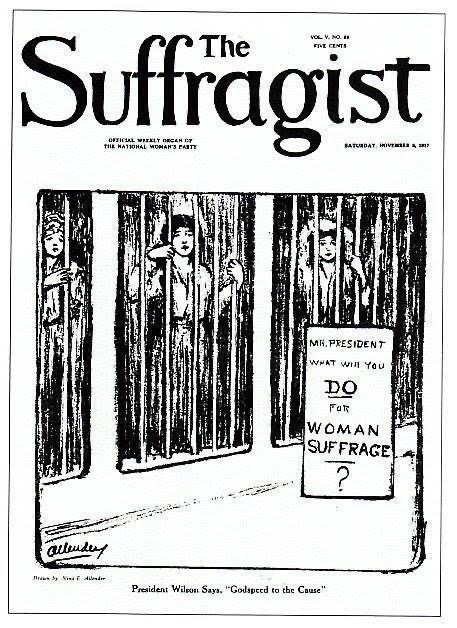
This image was featured on the front cover of an article of the National Woman’s Party’s publication on November 17th, 1917, during the imprisonment of the suffragists including Dorothy Day at the Occoquan Workhouse (16).
Reasons for and against women’s suffrage were not divided into black and white categories. In some cases, organizations only became inclined to support suffrage once they recognized how women might vote in favor of issues crucial to maintaining their power. The historian and theologian Kathleen Bonnette argues that Catholic leaders, for example, “began to recognize the usefulness of Catholic women voting on behalf of Catholic family values” (17). Even though pro-suffrage stances held by these leaders positively impacted the lives of women and society as a whole, the motives behind these decisions did not necessarily have the true pursuit of justice as their main goal. Day’s form of religious activism later in life tended to approach problems like this from an entirely different angle: solely seeking fairness and equality.
The bare and desolating environment of the Occoquan Workhouse drained Day both physically and emotionally. As she reflected on the injustice of her own sentence, she could not help but feel chained down by discrimination she knew was actively happening across the world to all types of people. This universal pain, Day writes, caused her to cling “to the words of comfort in the Bible…Yet all the while I read, my pride was fighting on. I did not want to go to God in defeat and sorry. I did not want to depend on Him” (18).
It was in jail that Day formed the connection between her passion for justice and the pieces of Catholic Social Teaching and tradition she had experienced as a child. Day realized how various Psalms of the Bible which spoke to her when she was young applied to her current situation: in jail, in suffering, in the middle of the fight. These words gave her courage, but only momentarily. While Day acknowledged the universal healing power of what the Church claimed to offer, she was afraid to accept that a solution to suffering required submission to God. Day writes, “I had seen myself too weak to stand alone, too weak to face the darkness of that punishment cell without crying out, and I was ashamed and again rejected religion that had helped me when I had been brought to my knees by my suffering” (19).
Even though she was hesitant to admit it at the time, from her experience witnessing pain and the ultimate success that came from fighting for justice, Day recognized a connection to the Catholic Church. In contrast, the Church’s perspective of these same issues Day actively fought for looked quite different. While Catholic bishops and laymen formed outsider opinions on the suffrage movement after searching for what might help the organized church gain more power, Day began to discover the true nature of Catholicism as she fought alongside suffragists in the thick of the action. Day’s political identity never negated her Catholic identity and vice versa: this was crucial to her way of life. Day was drawn to the suffragist cause because she wholeheartedly believed in the importance of acknowledging women as individuals, not to gather additional votes for another cause. Day also tended to follow her own moral compass in relation to these types of events. Even after so fervently protesting for women’s right to vote, Day herself refused to vote in every opportunity after, “believing that our social constructs were too corrupt and dysfunctional to foster real justice” (20).
Day’s understanding of corruption within all political organizations, whether they be the Church or a national government, directed the bold choices she made in her daily life. While this controversial stance may be debated today, it certainly proves Day’s commitment to her beliefs. The “Night of Terror” at the Occoquan Workhouse not only began to stir within the world a call to challenge injustice women faced but also a stir within Day’s heart as she began to sense the light of faith.
Politics and the Church
“A friend of mine once said it was the style to be a Catholic in France, nowadays, but it was not the style to be one in America. It was the Irish of New England, the Italians, the Hungarians, the Lithuanians, the Poles, it was the great mass of the poor, the workers, who were the Catholics in this country, and this fact in itself drew me to the Church” (21).
The more Day continued fighting for social justice and equality, the more her political ideas and questions about Catholicism began to converge. While Day worked for socialist-adjacent organizations in her young adulthood, no certain political party captured her attention enough to fully support. For this reason, paired with Day’s other moral beliefs, many historians define her as a “Personalist.” While a personalist world view isn’t necessarily a religious one, the two work together hand in hand. For example, journalist Daniel Akst describes personalism as a worldview that highlights community and dignity, defining each person’s worth based on something only God can dictate (22).
In her early 20s, when Day’s main activism was in the realm of political freedom, she was already a very skilled fighter against inequalities in organizations and personal situations. However, Day came to better understand the concept of dignity and discover a gentler patience within her when she stepped away from the political world for a year to work as a nurse during the Spanish Flu pandemic of 1918. This change of scenery is incredibly important to Day’s story and growth, especially to her conversion, because it once again brought her face to face with poverty and suffering, but this time, it was with a different population: the sick. Day reflects particularly on an enlightening experience with an elderly woman on the verge of death. This 94-year-old actively “began to fight with the nurses, clawing at them and screaming and sitting in the middle of her bed like a whimpering monkey” (23).
While this struggle could have just as nearly been caused by physical pain or mental turmoil about the end of her life, it was actually something much simpler but simultaneously much more complex: shame. It turns out, this woman was crying out for her wig because she was ashamed of her hair loss due to sickness and aging. Even worse, the other nurses seemed not to care, attempting to treat her with “love” but not actually listening to her requests. Coincidentally, it was one of Day’s Catholic colleagues, Miss Adams who teamed up with her to find a solution. Miss Adams shared with Day how “the little old lady needed more than soap and water and clean bed linen. She needed more than to be loved. She wanted to be respected as a person” (24). In this moment, Dorothy Day, who had previously been solely a spunky, loud, and upfront fighter sensed a more modest form of compassion centered around care for the individual.
While feeling sure of the existence of God was never quite a struggle for Day, it was the organization of the Church itself and opinions of others that still held her back from converting. In Day’s own political advocacy, she “emphasized personal responsibility,” instead of simply relying on the government, or “‘Holy Mother State’, as she called it” to solve the problems of the world (25). Because of Day’s extreme anti-government stance, many of her other politically-involved friends were shocked when she shared with them about her callings to the Church. They “looked upon religion as the opiate of the people –” the strongest form of propaganda, deception, and organization possible. And while Day did acknowledge that the need to join the Church itself was essential to fully participate in the Body of Christ, the only thing that really mattered to her was living a life of faith: serving others with radical love and justice. Kate Hennessy, one of Dorothy Day’s grandchildren, shares in an interview about this anti-establishment view of the Church: “I think that you can really get caught up in proceduralism or institutionalism and lose the sight of the heart of a matter. And I think that’s her genius, is that she never lost sight of the heart of the church” (26). Day’s longing to be with and for the poor, the unattractive, and the unpopular continued to guide her heart to conversion.
Family and Conversion
“Forster had made the physical world come alive for me and had awakened in my heart a flood of gratitude. The final object of this love and gratitude was God. No human creature could receive or contain so vast a flood of love and joy as I often felt after the birth of my child. With this came the need to worship, to adore…My very experience as a radical, my whole make-up, led me to want to associate myself with others, with the masses, in loving and praising God” (27).
All while finding her true self and searching for answers in the Catholic faith, Day was also dealing with relational struggles with the goal of creating a family of her own. However, as a young adult, finding and maintaining healthy relationships was a major struggle. Day’s early twenties were a time of great self-doubt and even self-hatred, leading her to attempt to take her own life twice (28).
However, none of these events are covered in The Long Loneliness. This could be for many reasons, these events were too traumatizing and triggering to mix into an otherwise uplifting story about conversion. Or perhaps because they are reflected on in another one of her many articles or works of literature, for example, The Eleventh Virgin. Or was it that she did not want to put a stain on her image by disclosing a fact the general public might not have known about? Despite the absence in her autobiography, it is still important to examine exactly what happened in these mysterious years of Day’s life to get a better understanding of why she converted and also to better understand the after-effects of her conversion which led her to exclude this part of her narrative. She first began a relationship with a young man, Lionel Moise, but after becoming pregnant, to her own delight, he pressured her into having an abortion. Day quickly spiraled and hastily married a much older man Berkeley Tobey. Day was his fourth wife. The two traveled the world and experienced a very lavish lifestyle, but Day was unhappy. With Tobey, she felt shackled and unable to express herself. After their traveling in Europe was complete, Day and Tobey divorced.
All of these major, life-altering events had taken place, and Day was only 24 years old (29). To combat the deep anger and confusion she felt, Day returned once again to the religious prayers and practices that had given her solace in times of struggle. However, this time, her loneliness was amplified more than it ever had been — she truly felt hopeless. The prayers did not have the same effect as they had in the past because she was flooded with doubt and shame from the decisions she had made. The Church was against abortion and adamantly anti-divorce. How could Day ever belong in an organization which she believed resented her actions and maybe even existence?
The Long Loneliness picks back up again after Day had found herself in a healthy and happy relationship with a man named Forster Batterham, a political activist like herself. While Day loved Batterham with all her heart, it was “impossible to talk about religion or faith to him” (30). In addition, he “did not believe in bringing children into such a world as we lived in…His fear of responsibility, his dislike of having the control of others, his extreme individualism made him feel that he of all men should not be a father” (31). But after her first abortion, Day’s longing for a child was even stronger. The regret she had over this decision filled her spirit with the desire not only to have a child, but also “have [her] child baptized, cost what it may” (32) After Batterham eventually agreed to have a child and Day became pregnant, this desire grew even stronger. Day writes: “I felt it was the greatest thing I could do for my child. For myself, I prayed for the gift of faith. I was sure, yet not sure. I postponed the day of decision…Forster would have nothing to do with religion or with me if I embraced it. So I waited” (33). Day knew she wanted to be Catholic because she felt a spiritual connection to the Church. However, she did not want to put her relationship at risk. She believed that Batterham would be more lenient with his future child being baptized than Day herself because it might be easier to hide from their other friends who, like Batterham, shunned any ideas of organized religion. The last few months of her pregnancy, Day stopped thinking about her own baptism because she wanted to preserve the happiness and comfort she had found with Batterham for as long as she possibly could. This was slightly out of character for Day because, as seen through her years of taking action against organizations and corporations, she was not one to conform. But in this moment with Batterham, she felt happiness and decided to put off her struggle for later.
“When the little one was born, my joy was so great that I sat up in bed in the hospital and wrote an article…wanting to share my joy with the world” (34). This article, published in The Catholic Worker in June of 1928 and crafted by Day, was one of her first nonpolitical articles to gain worldwide publicity. The story details the pain and suffering of the waiting and labor process, then skips ahead to a serene and peaceful scene of Day gazing down upon her newborn child filled with unexplainable joy and delight (35). Day writes, “it was a joy all women knew, no matter what their grief at poverty, unemployment and class war” (36). Day’s experience with this boundless joy opened her heart to contemplating where else she had lived in this joy before. While she was truly in comfort with Batterham, she had only ever felt this soul-stirring delight at times of prayer and worship. She knew even more confidently what the next step to take must be, but she was still not ready: “There had been the physical struggle, the mortal combat almost, of giving birth to a child, and now there was coming the struggle for my own soul. Tamar would be baptized, and I knew the rending it would cause in human relations around me. I was to be torn and agonized again, and I was all for putting off the hard day” (37).
The decision to have Tamar baptized was easy, but Day did not know what steps to take to accomplish the action. Only after running into a random nun on the street named Sr. Aloysia was Day able to take practical steps to make her wish a reality. While Sr. Aloysia was eager to help Tamar enter the Church, she questioned the nature of Day’s request because Day herself was not Catholic and “speculated rather volubly at times on the various reasons why she thought [Day] was holding back” (38). However, Sr. Aloysia relentlessly helped Day with Tamar while simultaneously giving Day novels, articles, and advice to aid in her own faith journey. Day noted in her autobiography that “this was a bridge too far for Batterham, the proud unbeliever. He left the cottage every time Sister visited to teach Dorothy catechesis, lest he be exposed to organized religion, which he feared and resented” (39). Day had tried for years to lead Batterham to a life of faith, but it just was not working. He believed that the problems of the world could be healed with an opposing political agenda, a practical stance, but Day’s understanding was much deeper. She writes, “If I could have felt that communism was the answer to my desire for a cause, a motive, a way to walk in, I would have remained as I was. But I felt that only faith in Christ could give me the answer” (40). Sr. Aloysia’s companionship coupled with the joy in Tamar’s entrance into the Body of Christ had led Day to a fork in the road, and it was time she made a decision (41).
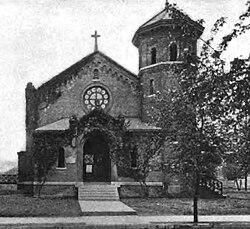
Church of Our Lady, Help of Christians in 1914. It was here on Staten Island where both Dorothy Day and her daughter Tamar were each baptized in 1927 (42).
Dorothy Day was an outcast. She had no clue if she would be welcomed into the Church because of her background. Would they not see right through her for all her faults and turn her away? If she were turned away, would she retreat back to Forster and live the rest of her life submitting to him? She knew the poor and the outcasts loved the Church, so why couldn’t the Church love her back? But then again, if she were able to enter the Church successfully, her husband, the man she loved most in the world, would leave her. Friends and political allies, too, would shun and mock her.
Either way, Day would face pain and hardship in an even more personal and spiritual sense than ever before. But Day was no stranger to rejection. As a young child, by forming habits like going to Mass and questioning the beliefs of her parents, she steered away from the majority in her family and forged her own path. When she moved to New York City to pursue her dreams as a journalist, she told the truth through her writings, spreading her wisdom and advice to a society willing to believe anything. As an enthusiastic suffragist, she took down plots of the patriarchy with her protests and advocacy, generating world-wide attention through her brave actions. She treated the dying with dignity, administering to the small wants of patients that were otherwise neglected by the other caretakers. She fought against war, acknowledging it as a scheme for money and power.
Day decided it was better to be rejected by the world than to never be at peace with herself. While the organized Church may have looked down on her, the God she believed in welcomed her with open arms, inviting her to sit before Him with all the other sinners and outcasts. And even though she chose to leave the man she loved, she accepted that the virtue of love stirring in her heart was given to her by a God who was love itself. By choosing that best version of herself: unafraid of rejection, willing to fight shame, and bursting with love for the suffering and poor, Dorothy Day chose Catholicism.
Jane Kramer is a strategic management major. Her essay was originally written for Professor Peter Cajka’s “American Microstudies” University Seminar.
References
- Day, Dorothy. The Long Loneliness: The Autobiography of the Legendary Catholic Social Activist. New York: Harper & Row, 1952.
- Day, The Long Loneliness.
- Day, The Long Loneliness.
- “Dorothy Day.” Wikipedia: The Free Encyclopedia. Wikimedia Foundation. Last edited n.d. https://en.wikipedia.org/wiki/Dorothy_Day.
- Day, The Long Loneliness.
- Day, The Long Loneliness.
- Photographs of History. “New York 1915.” Photographs of History, n.d. https://www.photographsofhistory.com/articles/new-york-market-1915.html.
- Day, Dorothy. “Hunting a ‘Story.'” New York Call, November 21, 1916, 3. Catholic Worker. https://catholicworker.org/67-html/.
- Day, The Long Loneliness.
- History.com Editors. “Russian Revolution.” History. A&E Television Networks, March 12, 2024. https://www.history.com/articles/russian-revolution.
- Day, The Long Loneliness.
- Day, The Long Loneliness.
- Day, The Long Loneliness.
- “Government Forced to Release Suffrage Prisoners from Occoquan.” The Suffragist 5, no. 97 (1917): 4–5. ProQuest. https://login.proxy.library.nd.edu/login?url=https://www.proquest.com/historical-periodicals/government-forced-release-suffrage-prisoners/docview/2629723429/se-2.
- “Government Forced to Release Suffrage Prisoners from Occoquan.” The Suffragist, 1917, 4–5.
- Dismore, David. Cover of The Suffragist, featuring the “Mr. President, What Will You Do for Woman Suffrage?” poster. Turning Point Suffragist Memorial, November 17, 1917. https://suffragistmemorial.org/november-17-1917/.
- Bonnette, Kathleen. “A Vote of Their Own.” U.S. Catholic 89, no. 11 (November 2024): 27–28. ProQuest. https://www.proquest.com/magazines/vote-their-own/docview/3122248206/se-2.
- Day, The Long Loneliness.
- Day, The Long Loneliness.
- Bonnette, “A Vote of Their Own,” 27–28.
- Day, The Long Loneliness.
- Akst, Daniel. “Dorothy Day: Personalist Hero.” Reason 52, no. 7 (December 2020): 12–13. ProQuest. https://www.proquest.com/docview/2451866663.
- Day, The Long Loneliness.
- Day, The Long Loneliness.
- Day, The Long Loneliness.
- “An ‘Intimate Portrait’ of Dorothy Day, the Catholic Activist with a Bohemian Past.” Fresh Air. NPR, 2017. ProQuest. https://login.proxy.library.nd.edu/login?url=https://www.proquest.com/other-sources/intimate-portrait-dorothy-day-catholic-activist/docview/1880145383/se-2.
- Day, The Long Loneliness.
- Doino, William, Jr. “Searching for Dorothy Day.” Human Life Review 46, no. 3 (Summer 2020): 37–46. ProQuest. url=https://www.proquest.com/magazines/searching-dorothy-day/docview/2448950395/se-2?accountid=12874.
- Doino, “Searching for Dorothy Day,” 37–46.
- Day, The Long Loneliness.
- Day, The Long Loneliness.
- Day, The Long Loneliness.
- Day, The Long Loneliness.
- Day, The Long Loneliness.
- Day, Dorothy. “Having a Baby — A Christmas Story.” New Masses, June 1928. Reprinted in The Catholic Worker, December 1977, 7–8. Catholic Worker Movement. https://catholicworker.org/583-2/.
- Day, The Long Loneliness.
- Day, The Long Loneliness.
- Day, The Long Loneliness.
- Doino, “Searching for Dorothy Day,” 37–46.
- Day, The Long Loneliness.
- Cook, Vaneesa. “The Unaffiliated Revolution of Dorothy Day.” Raritan 37, no. 4 (2018): 70–96, 162. ProQuest. https://login.proxy.library.nd.edu/login?url=https://www.proquest.com/scholarly-journals/unaffiliated-revolution-dorothy-day/docview/2047357810/se-2.
- Lore, Diane C. Staten Island Advance, March 3, 2016. https://www.silive.com/timecapsule/2016/03/vintage_photos_facts_about_our.html.

