
By Anna Bellocchio ’28
Emerging from the punk and BDSM communities of New York in the late 1970s, Robert Mapplethorpe photographed and shaped the visual language of queer identity, desire, and the art world through highly stylized studio photography. His work explores the intersection of eroticism, beauty, and queerness. Mapplethorpe approached his subjects with control and intention, frequently combining classic aesthetics with the contemporary world of the 80s. Mapplethorpe was known for creating meticulously composed black-and-white photographs that elevate the body, flowers, and portraiture into iconic, classical forms. He also produced influential commissioned portraits of celebrities, bringing his formal aesthetic into the mainstream art world and receiving recognition. Mapplethorpe’s striking self-portraits documented his shifting identity, career, and physical decline with an unflinching and performative gaze, leading up to his AIDS-related death in 1989. In this sense, Robert Mapplethorpe’s Self-Portrait (1988) is a meditation on the reality of death within the AIDS crisis. By comparing Mapplethorpe’s 1988 piece to Self-Portrait, Drag (1980), we see how Mapplethorpe uses self-portraiture to move from theatrical role-playing toward an unguarded memento mori that binds life and death into a single visual narrative.
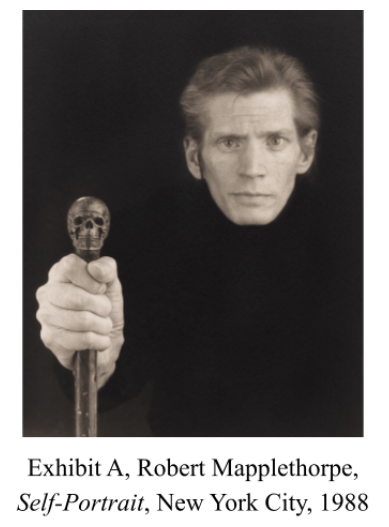
Self-Portrait is a stark contrast to much of Mapplethorpe’s larger body of work, particularly within portraiture (see Exhibit A) (1). Mapplethorpe’s broader collections often feature black-and-white self-portraits in various personas, with himself being his most photographed subject (2). However, rarely did Mapplethorpe employ such stark minimalism that emphasizes foreboding seriousness over eroticism or sculptural perfection. By the time the photograph was taken, Mapplethorpe had been diagnosed with AIDS and was aware of the inevitable death sentence that accompanied it (3). Self-Portrait exemplifies a late tonal shift in Mapplethorpe’s style, marked by his introspection and diagnosis. He reflected, “To me the most important thing is my experience, and not anything else. I care more about that than anything—I care about what I’ve gone through” (4). The image is aggressive and uncomfortable, where Mapplethorpe’s gaunt face and stare confront viewers with his impending death from AIDS. Although the photograph was not the final piece published by Mapplethorpe, it was a way of presenting himself to the public in the face of mortality.
The image, Self-Portrait, presents Mapplethorpe’s head and hand clenched onto a skull-topped cane, alone in near-total darkness. The viewer’s eye is immediately caught between the skull and Mapplethorpe’s uncomfortable stare. His hair is short and carefully styled, with strips of lighter, perhaps gray, hair throughout. The muscles of his face are relaxed but alert, steady, and restrained. The black-and-white color of the photo draws particular attention to the subject’s wrinkled and sunken expression, shadowed where light does not reach into the crevices. The background is a solid, endless black, offering no sense of location, just an empty void that presses around him. His body blends and disguises effortlessly into the dark abyss; only the faintest sheen along the sleeve suggests that Mapplethorpe is wearing a dark garment.
Further, the head appears to be floating in midair, detached, severed, and disembodied. The light catches only his face and the skull of the cane, isolating them like two pale shapes suspended in an empty void. His fist is gripped around the cane, smooshing the wrinkled fingers through a tight grip. The head is noticeably further back from the camera than the staff, leaving the head blurred as if it is dissolving into the negative space. The cane and hand, in contrast, are highly detailed, revealing the subtle imperfections and wood-grain of the cane’s shaft. The cane’s handle is shaped like a small dark skull. The skull catches the strongest light in the image, its smooth, hard surface shining more brightly than his skin. Notably, the skull has a crack reaching from the middle forehead to the eye socket, signifying wear and age. The cane itself descends into the darkness, vanishing as it reaches the bottom of the frame, as if it has no end.
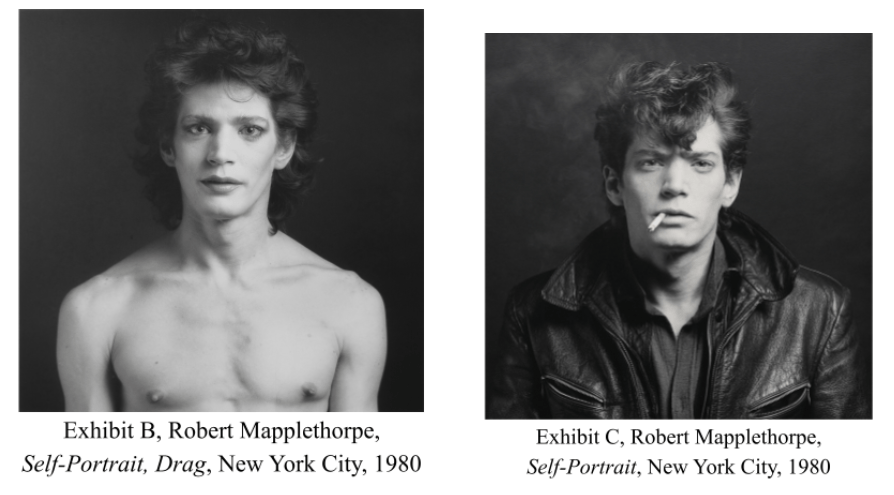
We might read this image alongside another work by Mapplethorpe, Self-Portrait, Drag (see Exhibit B) (5). Mapplethorpe’s early work consisted primarily of self-portraits in which he played with male and female conventions, employing various cosmetic and satirical archetypes such as drag, S&M dynamics, and smoking greasers (see Exhibit C) (6). Mapplethorpe’s self-portraits were driven by honesty in the interest of discovery and personal truth (7). The image Self-Portrait, Drag is no exception. The juxtaposition of Mapplethorpe’s serene stare with elaborate makeup is a playful nod to queerness, perhaps with a hint of mischief.
The second photograph, Self-Portrait, Drag, utilizes self-portraiture with a different intent, capturing a soft playfulness and theatrical elegance. The photo again features Mapplethorpe in black-and white silvery tones. The viewer is immediately drawn to his wide-open gaze, facing the camera straight-on with an aura of poise. Although lacking color, his face is strikingly painted with bold, feminine makeup, resembling drag-inspired aesthetics. His lips, partially separated, and eyes are painted with rich, dark lines and shaded with matte, smoky tones. His hair is intentionally messy, forming into lustrous soft waves around the face and covering the tops of the ears. His bare chest is visible toward the camera, cleanly exposing his collar and spine definitions. His body appears healthy and naturally slim. His skin catches the soft light in a way that highlights the natural contours of his body. There is no slouch, tilt, or shifting weight in how Mapplethorpe carries himself; he holds his head high and centered with the shoulders dropped. The background is not an absolute black, but a lighter, smooth surface. Light shines in from the top-left corner, creating subtle shadows and tones across his body.
Across these self-portraits, Mapplethorpe moves away from staged role-playing toward a more exposed and unguarded presentation of the self through the memento mori style. Memento mori is a Latin phrase meaning “remember you must die,” and is commonly tied to symbols of skeletons, hourglasses, and — most notably — skulls (8). Artwork within memento mori is designed to remind the viewer of their mortality and the fragility of life. When compared to Mapplethorpe’s typical work, such as Self-Portrait, Drag, we see how Self-Portrait discovers this style as an unsettling and blunt confrontation with his own mortality. Self-Portrait, Drag shows Mapplethorpe dressed in partial drag, playing a role as a stylized crossdresser. It is a carefully curated theatrical performance where he is styled, lit, and framed to be looked at. The curious and relaxed stare draws the viewer to interact with the image, as Mapplethorpe is presented to them as a character. Through this constructed persona, Mapplethorpe blurs his gender identity, where he “wanted to have the experience of looking like a woman” (9). He uses costume, makeup, and flamboyance to present an identity that is worn rather than lived, a facade.
Self-Portrait abandons this role-playing entirely. The absence of costume eliminates any sense of persona, utilizing a stare in much a different manner. The stare is tense, aggressive, and menacing from the eyebrow furrows and sunken skin. It is straight-on and unwavering, difficult to look away from its sharp, confrontational intensity. Tied in with memento mori, the stare gives a blunt presentation of the realities of death where the viewer cannot help but acknowledge his skeletal appearance. The cane and skull function as explicit memento mori, replacing the expressive body with symbols of death. The skeletal staff takes center stage in the photograph next to the head, serving as a reminder of what is inevitably next for Mapplethorpe: decomposing into a skull. By infusing memento mori in an aggressive, unguarded manner, Mapplethorpe is no longer self-fashioning a protective layer of performance but confronting his fate of eventual death.
The role of the body functions as the primary site where life and mortality are negotiated, shifting from a display of vitality to a fragile marker of physical deterioration. The body functions as a site of meaning, carrying emotional and symbolic weight as an indication of health and corporeal strength. In Self-Portrait, Drag, Mapplethorpe’s chest is uncovered and exposed down to the nipple-line, serving as an anatomical marker of the chest and heart. The chest is raw, caught in the midst of a breath; the viewer can see moles, protruding veins, and a ribcage outline as the shadow casts down on the body. Mapplethorpe’s bare chest illuminates a sense of curiosity and naivety in the image. Mapplethorpe’s body is intact, where there is a physical openness that highlights the flesh and form of an animated body. The body is undoubtedly full of life.
By the time we as viewers experience Self-Portrait, feelings of openness and vitality have faded, torn down by the impermanence associated with the deteriorating, vanishing body parts. Mapplethorpe’s body is not presented as whole, but as fragmented, dissolving parts. There is a gradual deterioration of the body as death takes over, where the blur of the head indicates that it is next to fade. What does remain, the head and hand, have clearly aged since Self-Portrait, Drag. The photos were taken just eight years apart, yet Mapplethorpe looks significantly older due to the toll of disease. The visible body itself serves as a reminder of death, with a structure that appears gaunt and sunken like a skeleton. The parts are floating, like that of a ghost. The bodies between the two images bring the viewer on an autobiographical journey, seeing Mapplethorpe’s body turn from whole and healthy into decaying parts. The progression from a whole, animated body to a fragmented, deteriorating one is evidence of mortality and is a direct acknowledgement of bodily decay.
In both images, negative space strategically manipulates presence and absence, heightening the tension between life and death. In Self-Portrait, Drag, light cascades in from one angle, resembling a spotlight shining down on Mapplethorpe. Mapplethorpe is presented with a strikingly androgynous persona against a plain, neutral backdrop, making the glamorized body and face the sole visual focus. Accentuating a stage-like theatricality, nothing in the background competes with the subject. The empty space eliminates distractions, heightening intimacy and performance by illuminating Mapplethorpe’s shape and makeup. Mapplethorpe’s figure is vividly alive, where negative space and shadow accentuate every contour, line, and imperfection, reinforcing a sense of life.
Self-Portrait, however, has a true emptiness that overwhelms and engulfs the image. The oppressive black is heavy and dominates the composition, making the head appear small, isolated, and swallowed by the abyss. The negative space does not just frame the subject; it asserts itself as a presence, giving the image existential weight. Disguised in the background, the void seems to have absorbed Mapplethorpe’s torso and is encroaching on the remainder of his head and hand, much like how AIDS permeates throughout the body and ravages one’s health. What the negative space does not conceal, the skull, further ties the absolute black to a sense of mortality. Read together, these opposing treatments of negative space work to emphasize the qualities of life and mortality, where one brings about a sense of vitality and the other finality. The negative space of the two photos are in conversation, confronting the viewer with the presence and isolation between life and death.
Mapplethorpe’s Self-Portrait and Self-Portrait, Drag reveal a conversation between life and death as he grapples with his impending mortality. The use of memento mori records not just personal decline, but the collective reality of illness and loss within the AIDS crisis. Through the use of body and negative space, the photographs use self-portraiture and composition to portray the narrative tension between life and death. Through erasure and compression, Self-Portrait creates a sense of blunt, impending doom that must be confronted directly, not evasively. Self-Portrait, Drag showcases vitality and theatrical performance, highlighting life and presence before mortality encroaches. By interpreting these images together, we gain an understanding into how an AIDS diagnosis physically tolls on its victims, while also grappling with the reality of death as it inscribes itself onto the living body. In doing so, Mapplethorpe compels the viewer to confront mortality not as a distant concept, but as an intimate and unavoidable human reality.
Anna Bellocchio is a political science major with a minor in constitutional studies. Her essay was originally written for Professor Anthony Petro’s American studies course “AIDS, Art, America.”
References
1. Mapplethorpe, Robert. Self-Portrait. 1988. Platinum palladium print. Solomon R. Guggenheim Museum. https://www.guggenheim.org/artwork/5354.
2. National Galleries of Scotland. “Self-Portrait, 1988 – Robert Mapplethorpe.” National Galleries of Scotland. Accessed December 13, 2025. https://www.nationalgalleries.org/art-and-artists/90652/self-portrait-1988.
3. Whitney Museum of American Art. Robert Mapplethorpe, Self-Portrait, 1988. March 3, 2011. Accessed December 13, 2025. https://whitney.org/media/707.
4. Indiana, Gary. “Robert Mapplethorpe.” BOMB Magazine, no. 22 (Winter 1988). Accessed December 13, 2025. https://bombmagazine.org/articles/1988/01/01/robert-mapplethorpe/.
5. Mapplethorpe, Robert. Self-Portrait, Drag. 1980. Photograph. Solomon R. Guggenheim Museum. https://www.guggenheim.org/artwork/2695.
6. Mapplethorpe, Robert. Self-Portrait. 1980. The Guggenheim Museums and Foundation. Accessed December 14, 2025. https://www.guggenheim.org/artwork/2683.
7, 9. Danto, Arthur C. Playing with the Edge: The Photographic Achievement of Robert Mapplethorpe. Berkeley: University of California Press, 1995. pg. 55, 53.
8. Walter, Debbie. “Memento Mori: A Positive and Contemporary Reflection Through Visual Art on a Life Spent Well.” IAFOR Journal of Arts & Humanities 6, no. 2 (November 20, 2019): 107–120. https://doi.org/10.22492/ijah.6.2.10.

