
By Evan Weltin ’28
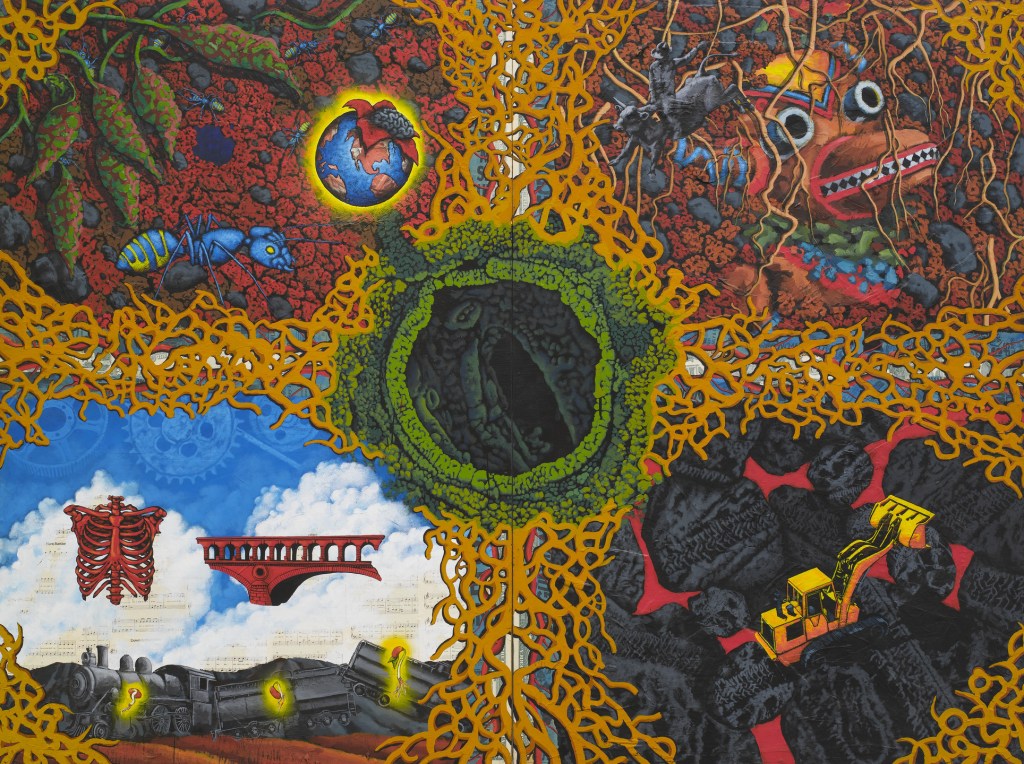
Earth by David Wojnarowicz (1).
From 1980 to 1987, the AIDS epidemic had claimed tens of thousands of lives in the United States (2). For a substantial portion of time, politicians in the federal government like President Ronald Reagan remained silent and unwilling to fund adequate healthcare and research in the midst of the epidemic largely due to the identities of those disproportionately affected by AIDS. AIDS particularly impacted gay and bisexual men, intravenous drug users, people with hemophilia, and Black and Hispanic populations (3).
The deliberate inaction of the United States government to protect the AIDS victims in marginalized communities caused death from AIDS to be often intimate, personal, and widespread in these communities. In this environment of loss and social abandonment, David Wojnarowicz created Earth (1987), a piece part of his larger Four Elements series, which also includes Fire, Water, and Air. Each of these four elements were mixed-media work on large panels measuring roughly 72 × 96 inches with acrylic and cut-and-pasted paper on wood. In its entirety, the Four Elements series attempts to capture Wojnarowicz’s personal grief over the death of his closest friend, Peter Hujar, while confronting the broader societal failures surrounding the AIDS epidemic. Within the Four Elements, Earth occupies a central position, providing a lens into Wojnarowicz’s worldview, his confrontation with personal and collective loss, and his critique of a society indifferent to the suffering of those most vulnerable to AIDS. Through its layered imagery of ants, machinery, money, and burial, Earth grapples with the ideas of mortality and the natural and social forces that determine whose lives are recognized and whose deaths are ignored. Earth functions as a material meditation on the epidemic that translates grief, labor, and systemic neglect into a visual language that renders the crisis tangible, urgent, and inseparable from the lived realities of the queer communities it devastated.
David Wojnarowicz met Peter Hujar in New York in 1981. The pair briefly began a romantic relationship that later became a close friendship and mentorship. By the time they met, Hujar was an established photographer who was especially interested in vulnerability, mortality, and the dignity of marginalized bodies. His examination of death and pain influenced Wojnarowicz’s decisions to look directly at suffering without sanitizing or minimizing it. Hujar had a tremendous impact on Wojnarowicz, both emotionally and artistically. In early 1987, Hujar was diagnosed with AIDS, passing away later that same year away. In his memoir, Close to the Knives, Wojnarowicz captures the raw reality of death, documenting what he feels and experiences just minutes after Hujar is proclaimed to be dead. As he sits with Hujar’s body, he writes, “a nun rushed in, babbling about how he’d accepted the church. I look at this guy on the bed with his outstretched arm and I think: but he’s beyond that. He’s more there than the words coming from her containing these images of spirituality. I mean, just the essence of death—the whole taboo structure in this culture, the mystery of it, the fears and joys of it, the flight it contains. This body of my friend on the bed, this body of my brother, my father, my emotional link to the world. This body I don’t know” (4). Being present at Hujar’s death fundamentally altered Wojnarowicz’s understanding of spirituality. In The Compression of Time, an interview in Wojnarowicz’s 1990 exhibition catalog Tongues of Flame, he recalls that the experience “completely broke apart any foundations of spirituality I’d come up with in my life” (5). This intimate and intense confrontation with Hujar’s death became a motivating force in much of Wojnarowicz’s work, as he often aimed to channel personal loss into visual art.
In 1991, at the Whitney Museum of American Art in New York, Wojnarowicz explained that he wanted to create the Four Elements series because he was “feeling a lot of pressure” from the likelihood that he would soon receive an AIDS diagnosis, especially as he was thinking about mortality after Hujar’s death. He described the series as a way to channel that pressure, putting “everything I knew about the world into a series of four paintings… basically do them, in effect, before I die, or at least that’s what I was afraid of having happen to me” (6). The creation of the Four Elements directly confronts Wojnarowicz’s own mortality, personal grief, and impending AIDS diagnosis, which he received in early 1988.
Choosing to organize this series around the classical elements carries substantial historical weight. Dating back to ancient philosophy and showing up in medieval medicine and Renaissance allegory, the four elements once shaped how people understood the body, temperament, and mortality, promising balance and cyclical renewal (7). By using this framework during the AIDS crisis, Wojnarowicz is not necessarily trying to restore order, but rather demonstrate how it has fallen apart. The elements exist in tension, fractured by mass death and social neglect.
Earth doesn’t offer comfort or stability. Instead, it becomes a place where bodies, labor, money, history, and grief literally and figuratively pile up into the Earth. If the four elements together try to capture the totality of life, Earth is where that totality lands and presses down. Seeing it this way, the painting isn’t just a meditation on nature, but instead a commentary on the political landscape shaped by the AIDS crisis in America.
One of the most striking aspects of Earth is Wojnarowicz’s use of ants. In the top left quadrant of Earth, Wojnarowicz paints a large, blue ant along with several much smaller ants. Insects, especially the use of ants, are a motif that recurs frequently across his work. Rather than functioning as isolated symbols, bugs appear repeatedly in Wojnarowicz’s paintings and photographs as analogues for human behavior. He sees ants, much like human beings, as organisms driven by instincts for survival, collectivism, labor, and operating within systems they neither control nor fully perceive. In Earth, this idea of physical labor is made explicit through the use of ants in nature and manmade heavy machinery. In the bottom right quadrant of the work, Wojnarowicz paints a yellow bulldozer, which can be seen pushing mounds of dirt. Wojnarowicz described the painting as an exploration of forces that physically move and shape the ground, visualized through the juxtaposition of a bulldozer and an ant (8). Though they are radically different in scale and have very different origins, as the ant is a living organism and the bulldozer is manmade, both perform the same essential labor. By collapsing distinctions between human and nonhuman activity, Wojnarowicz aligns industrial development with instinctual behavior, suggesting that technological progress does not elevate humanity beyond its most basic drives.
The analogy is strengthened by the visualization of the large queen ant surrounded by smaller worker ants. Rather than romanticizing the idea of collective physical labor, Wojnarowicz frames it as relentless and unreflective. As Cynthia Carr, author of Fire in the Belly: The Life and Times of David Wojnarowicz, observes, ants in his work represent “humanity rushing along, heedless of what lies under its tiny feet, indifferent to the structures that surround it” (9). Within the context of the AIDS crisis, this indifference becomes devastating. While ants continue their work without pause, bodies are buried in the ground. Life above, like work and commerce, persists, while death below remains unacknowledged. Wojnarowicz’s insects do not simply symbolize natural and biological aspects of the Earth, but instead expose a society capable of sustaining itself only by refusing to recognize the cost of its own momentum.
Wojnarowicz reinforces this critique through the visual pairing of a bridge and a ribcage in the bottom left quadrant of Earth. Here, he paints both items the same shade of red, clearly indicating a connection between the ribcage and bridge. Explicitly noting their architectural similarity, he emphasizes the similarities between human anatomy and built infrastructure. Both are structures designed to bear weight until they fail. In the context of AIDS, this comparison becomes even more tangible. The ribcage houses lungs and breath, systems that can become complicated or fail when afflicted with disease. This interplay between anatomy and infrastructure sets the stage for Wojnarowicz’s broader meditation on systems of support and neglect. Just as the body’s physical structures are vulnerable to collapse, so too are social and economic structures, which echoes his treatment of money and capital within the painting.
Wojnarowicz himself lacked health insurance and depended on the sale of his artwork to fund medical care. He often linked this idea to his work by using images of United States currency. As he explained in testimony regarding his 1989 piece Bad Moon Rising, “‘I painted all this on top of US currency to show several of the economic aspects of the epidemic: The fact that I don’t have health care insurance and basically have to rely on my works or the sale of my works to take care of my health” (10). In Earth, currency is embedded into the background rather than isolated or framed. Money is not external to death; it is buried alongside bodies, gears, and machines. Capital becomes part of the ground itself, determining whose lives are supported and whose are allowed to collapse.
Other visual elements in Earth reinforce this sense of historical accumulation and the compression of time. The faded gears behind the ribcage and bridge emphasize the invisible, relentless systems that continue to operate while individual lives are consumed. This works to highlight the mechanized indifference that shapes who survives and who is forgotten. Nearby, a locomotive from the early 1900s, a symbol of American expansion and modernity, lies wrecked yet sprouts vegetation, suggesting both the persistence of mechanization and the potential for life and rebirth. The figure of a cowboy in the top right portion of the painting introduces another layer of historical critique. Once a dominant symbol of American masculinity and conquest, he is here diminished, nearly swallowed by the composition, linking the AIDS crisis to longer histories of American violence, expansion, and erasure. As Wojnarowicz explained in a transcript created for Felix Guattari, he sought to “play with the compression of time… with a locomotive from the early 1900s… with a cowboy from the 1960s… I play with time, I play with distance, and I break the boundaries of both” (11). History in Earth does not disappear. Instead, the ideas of time and history are compacted, layered, and pressed into the soil, creating a record that both reflects Wojnarowicz’s personal sense of time and challenges the sanitized historical narratives imposed by society.
In the top right corner, a partially buried ceremonial mask references Hopi kachina figures emerging from the soil. Kachinas are small wooden figurines used by the Hopi people, a Native American tribe native to Northern Arizona, to represent benevolent spirit beings that are essential to the world, nature, and community responsibilities. The kachina dolls often serve as messengers for rain, fertility, and well-being. Indigenous cosmologies had long provided Wojnarowicz with models of cyclical life and rebirth, and because of Hujar’s death, he became hyperaware of the instability of his own spiritual appropriations, later describing them as “odd cannibalizations of different cultures” (12). In discussing Earth, Wojnarowicz explained, “there are references to the kachinas, the early Hopi spiritualities. There’s the little grey image towards the top of a cowboy riding a bull. It’s very difficult to see. I was thinking of things that move the earth around, so there’s an ant in the upper left-hand area and then there’s a bulldozer in the lower right-hand area. I was thinking of things like architecture and ideas of architecture, intuitive ideas of architecture, so there’s a rib cage and then there’s a bridge. I’m thinking of the similarities between the two” (13).
In Earth, the kachina is buried like other elements of the work that represent the accumulation of life, labor, and history. The work refuses any easy sense of spiritual comfort. Rebirth happens, but it’s physical rather than metaphysical. Life continues without guarantees, insects keep moving, plants grow from the ruins, and grief doesn’t disappear but rather becomes part of the soil itself. By layering personal, historical, and ecological details, Wojnarowicz turns Earth into a landscape where death, survival, and continuity exist together in raw, unavoidable clarity.
In the center of the painting, and conceptually at its core, a massive hole lies in the heart of the composition. This void can be read in several ways, depending on the viewer. It can be seen simultaneously as a grave, a wound, an excavation site, insight into the center of the world, an absence of emotion or feeling, or some combination of any of those ideas. The hole is importantly unsealed. There is no sense of physical or spiritual closure, no surface of resolution. Instead, the hole remains open, structuring everything around it. The hole becomes the space where loss accumulates, where the dead remain present even as life continues above them.
Earth offers an understanding of the AIDS crisis through life, death, and human vulnerability. Rather than depicting illness directly, Wojnarowicz renders AIDS as a condition of weight, a physical pressing of bodies into the ground while social, economic, and historical systems continue uninterrupted. By organizing his grief and worldview around the idea of four elements, Wojnarowicz did not aim to find order and solace. Instead, he used his understanding of the world around him to provide insight into his grief, personal struggle with the idea of mortality, and what it means to be alive. Earth depicts the physical and metaphorical accumulation of bodies, labor, capital, and grief under a society structured to ignore them.
Ultimately, Earth transforms Wojnarowicz’s personal grief over Peter Hujar’s death into a broader reflection of mortality and social neglect during the AIDS epidemic. Wojnaorwicz uses both literal and figurative symbols to depict bodies, labor, capital, and the natural world, allowing grief to function as a tangible, material force. Earth reveals the human and systemic mechanisms that determine whose lives are recognized and whose deaths are ignored. In doing so, Earth not only serves as a unique aspect of Wojnarowicz’s Four Elements series but also as a powerful record of the AIDS epidemic, where personal mourning, collective loss, and social critique can converge through art.
Evan Weltin is an American studies and Africana studies major with an education, schooling, and society supplementary major. His essay was originally written for Professor Anthony Petro’s American studies course “AIDS, Art, America.”
References
- Wojnarowicz, David. Earth. 1987. Acrylic and cut-and-pasted paper on wood, two panels. 72 x 96 in. (182.9 x 243.8 cm). Gift of Agnes Gund. Museum of Modern Art, New York. https://www.moma.org/collection/works/108180.
- Centers for Disease Control and Prevention. “HIV/AIDS Surveillance Report: Cases of HIV Infection and AIDS in the United States, 1981–1990.” MMWR 39, no. 48 (1990): 849–853.
- Centers for Disease Control and Prevention. HIV and AIDS — United States, 1981–2000. MMWR. U.S. Department of Health and Human Services.
- Wojnarowicz, David. Close to the Knives: A Memoir of Disintegration. New York: Vintage Books, 1991, 102.
- Wojnarowicz, David. “The Compression of Time.” In Tongues of Flame, edited by Barry Blinderman. New York: Universe Publishing, 1995, 49.
- Wojnarowicz, David. Quoted in Whitney Museum of American Art audio guide for David Wojnarowicz: History Keeps Me Awake at Night, 2018. Whitney Museum of American Art, New York. Transcript.
- Jardine, Lisa. Ingenious Pursuits: Building the Scientific Revolution. New York: Nan A. Talese/Doubleday, 1999, 45–46.
- Wojnarowicz, “The Compression of Time,” in Tongues of Flame, 58.
- Carr, Cynthia. Fire in the Belly: The Life and Times of David Wojnarowicz. New York: Bloomsbury, 2012.
- Wojnarowicz, David. Brush Fires in the Social Landscape. New York: Aperture Foundation, 1994, 45.
- Wojnarowicz, David. In transcript created for Felix Guattari. Brush Fires in the Social Landscape. New York: Aperture, 1997, 33.
- Wojnarowicz, “The Compression of Time,” in Tongues of Flame, 58.
- Wojnarowicz, quoted in Whitney Museum of American Art audio guide for David Wojnarowicz: History Keeps Me Awake at Night. Transcript.

