By Marie Stier ’29
A feminist, eugenicist, egalitarian, Christian, and natural selection-advocate walk into a bar. No, there’s not a conversation that leads to the joke’s punchline. She’s the only one in the bar. Charlotte Perkins Gilman is, on the surface, a deeply contradictory person. She was an advocate for female empowerment yet also an advocate of eugenics-based birth control, a believer in equality yet deeply racist, religious yet a follower of evolutionary science. Through all of her layers, one theme arises: agency. For Perkins Gilman, agency meant the ability to independently determine the course of her life — socially, economically, and politically — regardless of (and often, in opposition to) societal pressures. Perkins Gilman, for better or for worse, took full advantage of every opportunity to live her life as she wanted to, culminating in her autobiography. The Living of Charlotte Perkins Gilman: An Autobiography should be studied not as a rejection of 19th century norms but as a contradictory product of it, a text which sought to challenge, yet often conformed to the culture in which it was produced.
Throughout her life, Perkins Gilman increasingly critiqued late nineteenth century American society and valued autonomy, yet still oscillated between radical and conservative beliefs and actions. For example, she chose to leave her family to gain independence, while advocating for broad independence for all women through their responsibility for the home and raising children. In many ways, her view is consistent with conservative ideals of womanhood. Perkins Gilman — especially early in life — often upheld many of society’s expectations placed upon young women of the time, despite efforts to oppose them. She fought against women’s economic and social dependence on men while reinforcing traditional gender roles. However, Perkins Gilman challenged conventional gender norms later in life, highlighting what one scholar called “injustices and limitations,” while “pushing at the boundaries of ‘true womanhood’” (1).
Decisively, Perkins Gilman was a feminist. She was a social reformer, pushing for the advancement of society to increase individual autonomy, especially for women. Yet, she was a racist, a xenophobe, a eugenicist. She was a revolutionary thinker, speaker, and writer — but was she truly revolutionary? In many ways, Perkins Gilman was conservative, reinforcing existing social norms even while she critiqued them. Did she actually change the social structures or did she only reshape them within acceptable bounds? In what ways did she challenge norms and in what ways was she simply a product of her culture? Ultimately, Perkins Gilman redefined what it meant for nineteenth century American women to have agency in their careers, families, and identities in a time where they were barred from full self-determination.
Her autobiography, published at the end of her life, reflects both her transformation and continuity of her self over time. Her changing self, and her autobiography by extension, serves as an examination of how Perkins Gilman maintained many of her culture’s conventions while simultaneously being one of the time’s most radical thinkers.
Death: Final Act of Autonomy
Perkins Gilman was complex and ever-evolving and her autobiography is often contradictory. The work itself details her life chronologically, but regularly departs on tangents that exhibit her values: politics and reform. Perkins Gilman began writing her autobiography — her final book — after being diagnosed with breast cancer in 1932. Her impending death frames the autobiography as Perkins Gilman’s last document, her last act of political and personal agency. The book, though a personal catalog of her life, maintains much of her role as a public political figure. Her autobiography was not published until after her death in 1935, in which she committed suicide as a form of self-euthanasia. In death she left a final document, a suicide note which was then published in newspapers:
“But when all usefulness is over, when one is assured of an unavoidable and imminent death, it is the simplest of human rights to choose a quick and easy death in place of a slow and horrible one. Public opinion is changing on this subject. The time is approaching when we shall consider it abhorrent to our civilization to allow a human being to lie in prolonged agony which we should mercifully end in any other creature. Believing this choice to be of social service in promoting wiser views on this question, I have preferred chloroform to cancer” (2).
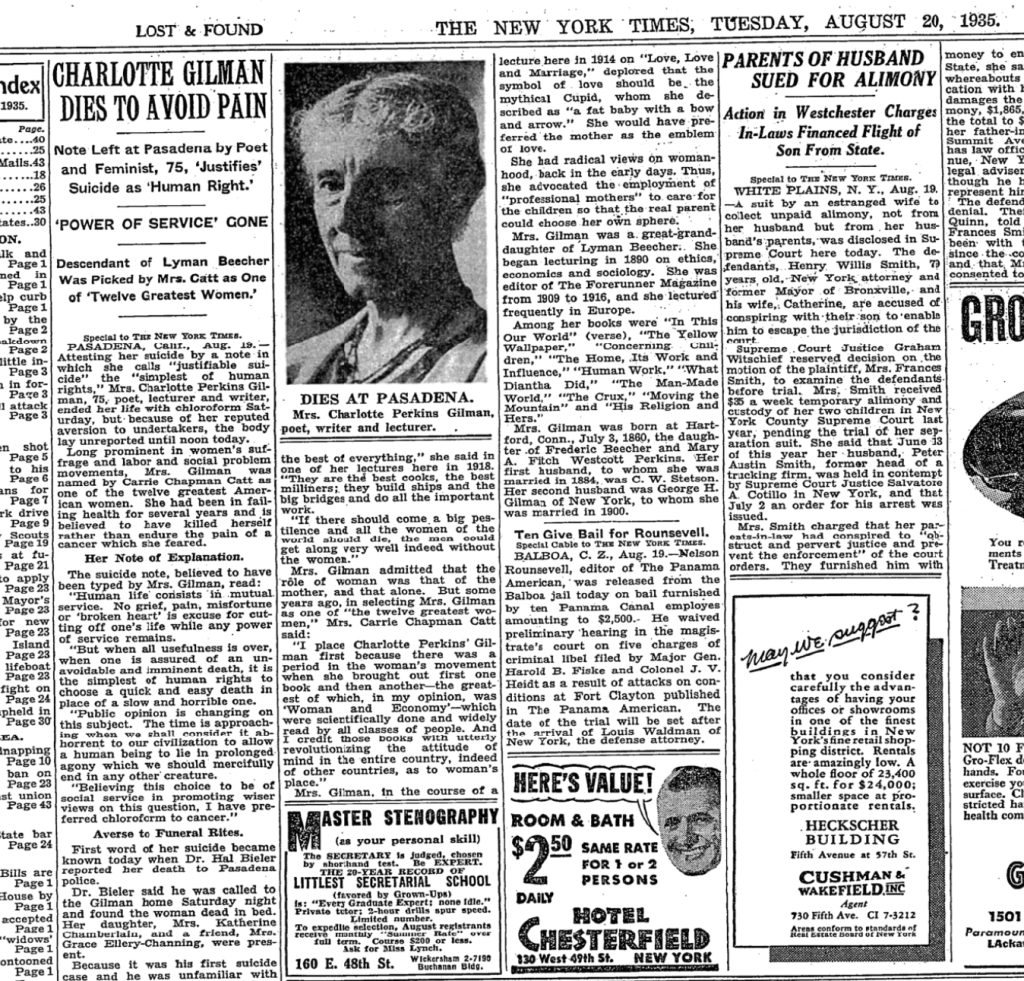
Coverage of Perkins Gilman’s death in The New York Times, Aug. 20, 1935.
Published on Tuesday, Aug. 20, 1935, three days after her death, The New York Times reports Gilman’s death and summarizes her life through the lens of her illness and decline. Rather than framing her death as an intentional political decision, the article, titled “Charlotte Gilman Dies to Avoid Pain,” frames Gilman as weak. After a long life defined by pursuing societal change and personal freedom, death was the ultimate, deliberate act of agency, the way to demonstrate full autonomy over her life. Rather than die passively from terminal breast cancer, Perkins Gilman’s death was her final political statement; self-euthanizing to conclude her lifelong advocacy for social reform and individual choice.
Childhood: Object to Subject
Perkins Gilman was born on July 3, 1860, in Hartford, Connecticut. Her childhood was marked by a physically distant relationship with her father, who left their family when Perkins Gilman was young, and an emotionally distant relationship with her mother, who kept her children at arm’s length. However distant from her parents, she still emphasizes how formative her early experiences were for establishing her lifelong pursuit of autonomy.
To start her autobiography, Charlotte Perkins Gilman writes the chapter, “Background,” which details her extended family’s history — beginning with their background as an introduction to her life. On nearly the first page, Perkins Gilman writes of her family’s contributions to nineteenth century politics, education, religion, and reform movements, highlighting that both the family’s men and women — something unique for the time — participated in societal advances.
“New thinkers appeared… making New England a seed-bed of progressive movements scientific, mechanical, educational, humanitarian as well as religious [improvement]. Into this moving world the Beechers swung forward, the sons all ministers, the daughters as able” (3).
In fact, her family’s modern legacy is largely attributed to the women, namely Harriet Beecher Stowe and Catherine Beecher, Perkins Gilman’s great-aunts. Their contributions centered on social reform and proved to be formative for Perkins Gilman. Perkins Gilman’s mother, known to be emotionally distant and closed-off, often brought her to visit her great-aunts. From this, Perkins Gilman obtained intellectual stimulation from these visits and, in combination with her father’s academic guidance, her childhood fostered independence and a deep curiosity in learning.
Perkins Gilman’s autobiography was a final, concrete record of who she was, a final chance to define her life for herself. Therefore, how she frames each aspect of her life reflects how she wants to be remembered. Perkins Gilman, by first introducing herself through her family, rhetorically aligns herself with them and therefore introduces herself as a product of her family relations. As her first “moment” with the reader, Perkins Gilman’s portrayal of her childhood reflects the contrast between agency and culture. By focusing on her family, she consciously contextualizes herself within their subculture, one that defines itself through its progressive reform and political activity.
Her progressive reform family primed her notion of autonomy. Because she had many role models of women in leadership and intellectual positions within the family, Perkins Gilman was at an early advantage for developing her own idea of autonomy.
When Perkins Gilman writes of her childhood imagination, she establishes her values of self-fulfillment and independence, common themes throughout her autobiography. Though many aspects of her childhood are characterized by a lack of control — namely her mother’s regular moving of the family across the Northeast — Perkins Gilman maintains a strong sense of conviction. “I avoided all those foolish mistakes made by the misguided persons in the fairy-tales, who had their wishes and made a mess of them. My first one was: ‘I wish that everything I wish may be Right!’ To be Right was the main thing in life” (4). Perkins Gilman, like many children, was often caught up in her imagination. Though wanting to preserve them, after being told to discard the fantastical worlds of her imagination by her mother, Perkins conceded. “But obedience was Right, the thing that had to be done, and I did it. Night after night to shut the door on happiness, and hold it shut. Never, when dear, bright, glittering dreams pushed hard, to let them in” (5).
Being “Right” is a common thread with Perkins Gilman: from early opinions in childhood journals to fully-fleshed social criticism later in life. However, to define what Perkins Gilman knows to be “Right” proves to be difficult. Her ideology, though strong, changes drastically through her life. In her childhood at least, “Right” is obeying authority.
In this way, Perkins Gilman acts as the “Object” of her life — life happening to her — rather than a “Subject” — where life happens because of her. Initially, Perkins Gilman accepts her role as Object, accepts being molded by her culture, particularly by her family. Later, Perkins Gilman refuses her mother and decides “she might do what she would, it could not alter my decision. I was realizing with an immense illumination that neither she, nor anyone, could make me do anything. One could suffer, one could die if it came to that, but one could not be coerced. I was born” (6). Perkins Gilman shows her first moment of freedom, a transition marking the beginning of a lifetime of seeking autonomy for herself through education, policy, and publication. By overcoming her internal struggle between societal demands of subservience and personal desires, she initiates the active relationship between herself and her surrounding culture. To be “Right,” then, is to hold beliefs that are independent of those in power, to have ideas that are her own and to act upon those ideas.
Perkins Gilman, previously Object, becomes Subject, rejecting passivity for activity, determining events rather than being determined by events. This shift exemplifies one of Perkins Gilman’s seemingly contradictory combinations: overcoming her environment while being created by it. Initially defined by her relationship to others’ — namely, her family’s — actions, then by demonstrating agency in determining her own, Perkins Gilman’s narrative structure mirrors the content of her autobiography. Her rhetorical choices begin with background, choosing to contextualize and give meaning to her life. Then, the narrative transitions into her relationship with her family members, gaining more self-identity, until she gets to moments later in life where she has more independence and free will over situations. At this point, the narrative reflects the shift happening in reality, with more personal “I” pronoun use and active verbs when Perkins Gilman becomes an independent woman.
Perkins Gilman — especially early in life — upheld many of society’s expectations placed upon young women of the time, as seen in an 1879 journal entry in which Perkins Gilman catalogues herself:
“Gentle reader, wouldst know me? Verily, here I am. 18 years old. 5 feet, 6 1/2 in. high. Weigh some 120 lbs or thereabouts. Looks, not bad. At times handsome. At others decidedly homely. Health, Perfect. Strength amazing. Character—. Ah! Gradually outgrowing laziness. Possessing great power over my self. Not sentimental. Rather sober and bleak as a general thing. At present I am not in love with anybody; I don’t think I ever shall be.”
Here, Perkins Gilman provides an essential insight into her mind, specifically as she emerges into adulthood. Her self-introduction exhibits society’s pressures of categorizing women first by their physical appearance. Beginning her autobiography with detailing her family shows Perkins Gilman based her identity on surroundings, and likewise, describing herself physically then her character exemplifies the tension between Perkins Gilman’s self and society. She mirrors the expectation that women prioritize their appearances and their minds come after. However, Perkins Gilman still counters the expectation of romantic relationships as a chief concern (though it is something she feels notable). In this way, Perkins Gilman remains Object in part. She, like many women of her time, cannot fully escape the confines that assign value to women based upon their appearance and adherence to convention.
Adulthood

Charlotte Perkins Gilman with her daughter, Katherine, in 1893 (7).
In 1888, Perkins Gilman left her husband, Charles Walter Stetson, for California, taking her three-year-old daughter Katharine with her. In California, Perkins Gilman first grew a small platform on the women’s movement and nationalism. However, she simultaneously found the combination of her career pursuits and domestic responsibilities — taking care of Katherine and her mother — became unsustainable, prompting her to move back East. She ended up in Chicago at Hull-House with famous reformers and writers such as Jane Addams and H.G. Wells, and sent her daughter Katherine to live with Stetson, whom she had divorced. This realization, that she needed to leave her daughter and husband to prioritize her intellectual pursuits and public career, highlights Perkins Gilman’s deep-rooted value of autonomy, especially in face of constricting social roles. In a 1913 essay, Perkins Gilman writes:
“That woman who loves children more than anything else in the world, who gladly consecrates her life to their care and service… will be one who will ‘understand’ where even mother love falls short. Mother love does not give human understanding” (8).
By asserting motherhood as a limiting perspective which cannot alone produce understanding, Perkins Gilman privileges rational thinking over emotional attachment. In doing so, she justifies her own exit from domestic responsibility — that she needed to separate from her family to gain more complete insight. In this way, she shows that detachment often coincides with gaining autonomy. Likewise, Perkins Gilman’s “unwavering commitment to public service in the face of potentially distracting personal matters” underscores a pattern of sacrificing personal for impersonal, rejecting relationships for reform (9).
Later in life, Perkins Gilman oscillated between radical and conservative beliefs and actions. While she decided to leave her family for independence, she advocated for the continued responsibility of other women for the home and raising children. Perkins Gilman writes: “The essential duty of the female as such is to exercise careful selection in choosing a father for her children.” Such an explicit assertion shows Perkins Gilman’s perspective on the role women should play in society as bound to their childrearing responsibility: women’s independence is conditional upon fulfillment of social expectations. She specifies that newfound independence economically should come as a sort of professionalized home-keeping. This qualification — establishing that autonomy is contingent on fulfilling society’s expectations — shows that Perkins Gilman’s agency is selective rather than universal.
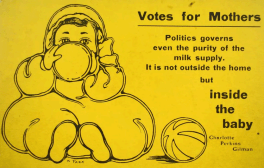
Perkins Gilman advocates for women’s suffrage by appealing to women’ s responsibility for their children (10).
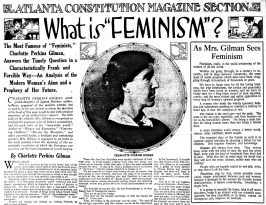
Perkins Gilman writes “The essential duty of the female as such is to exercise careful selection in choosing a father for her children,” in the Atlanta Constitution Magazine Section (11).
In Women and Economics: A Study of the Economic Relation Between Men and Women as a Factor in Social Evolution, Perkins Gilman aims to frame gender inequality as a social rather than a biological structure (12). Perkins Gilman argues that the shortcomings of a society can be seen in the economic dependence of women. She critiques the traditional home and advocates for women’s increased labor role outside the home. Framed by her early adoption of Darwinism, Perkins Gilman’s concept of social evolution places women at the forefront: the agents of social change through their economic independence and their selective reproduction. While she is now often viewed as a radical political thinker of her time, Perkins Gilman’s progressivism was bounded by her class and race.
Though highly accomplished in advocating for women’s rights, Perkins Gilman’s social philosophy was often accompanied by racist and ableist perspectives. Perkins Gilman believed personal autonomy to be a fundamental human right, but did not extend this right to all people. Perkins Gilman, an advocate for women’s empowerment, openly advocated for the compulsory sterilization of Black and disabled women. She actively promoted eugenics, and as one scholar frames it, “invested in an eugenic politics that sought to control the larger body politic by regulating women’s reproductive choices,” showcasing her dichotomous advocacy for some women’s autonomy and others’ control (13). Compared to her demand for full autonomy in her own life, Perkins Gilman was willing to restrict the autonomy of others. In that way, her progressive ideals were filtered through the racial biases of her era, which were so deeply rooted she felt justified denying autonomy to those she deemed racially inferior.
In 1908, Perkins Gilman founded The Forerunner, an independently-produced monthly magazine which featured her nonfiction, fiction, and poetry. Its purpose, to “stimulate thought; to arouse hope, courage and impatience; to offer practical suggestions and solutions,” often meant using the platform to promote both racial and ableist eugenics. A 1910 issue featured a fictional story called “The Crux,” which detailed a New England woman who has to contend with whether she will marry and have children with the man she loves while concerned about “[harming] the national stock” (14). The article sheds light on the intersection of Perkins Gilman’s beliefs about birth control as a tool of liberation — in which women attain bodily autonomy — and as a tool of subjugation — in which some women are denied this ability.
Likewise, in 1908, Perkins Gilman published “A Suggestion on the Negro Problem,” writing, “We have to consider the unavoidable presence of a large body of aliens, of a race widely dissimilar and in many respects inferior, whose present status is to us a social injury” (15). Here, Perkins Gilman frames African Americans as a biological and social problem, rather than recognizing them as people. Perkins Gilman, an early adopter of Social Darwinism, argues for the “advantage of contact with our more advanced stage of evolution,” arguing that the progress of African Americans is dependent on white society.
Her social Darwinist ideology set the foundation for many of her political views throughout her life. Early on, Perkins Gilman asserted that natural laws would ultimately lead to an improved and evolved society. However, as she got older, she increasingly supported a more involved approach, one which utilized social intervention and regulation. Her novel Herland, which features a utopian society composed of only women, shows both her progressive beliefs about women’s independence and her conservative beliefs about preserving the social body.
Throughout her career, Perkins Gilman increasingly critiqued society, regardless of shifting public popularity. Like in her final note, Perkins Gilman was aware of public opinion changing on many issues, but did not often let this influence her own beliefs. She knew that euthanasia was highly unpopular, but did not let this deter her in enacting control over the end of her life. Indeed, Perkins Gilman was often estranged from other contemporary radicals. Perkins Gilman “did not unquestioningly and unhesitatingly embrace all of the beliefs and ideals supported by American socialists,” primarily because of “oversight or dismissal of class issues in her social philosophy, something that obviously estranged her from Marxist circles” (16). In this way, her ideas on reform were limited by her inability to compromise on her beliefs in order to support a larger cause.
In her poem, “The Socialist and the Suffragist,” the Socialist dismisses the Suffragist’s cause, claiming it is too narrow to apply to the general population. In this way, Perkins Gilman critiques the reform movements that fail to recognize women’s central role in progress. However, she inadvertently does the same: excluding marginalized groups from her political advocacy.
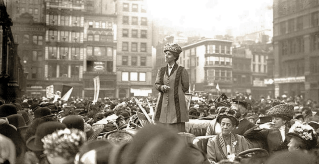
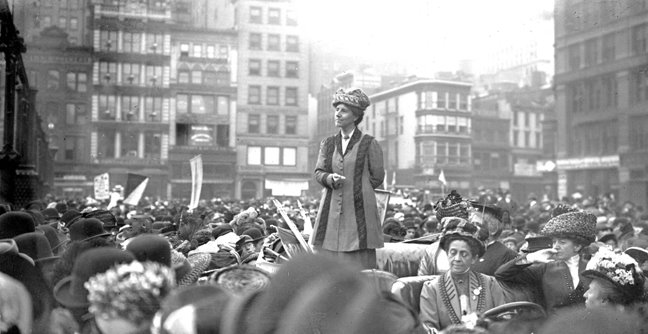
Perkins Gilman lectures to crowds in Union Square (17).
Because she was alienated from other radical reformers of the time, Perkins Gilman was often positioned as a solitary intellectual rather than a member of a larger reform group. As pictured in the Union Square, Perkins Gilman stands elevated, apart from the crowd, highlighting her practiced confidence in front of crowds but also her separation from those to whom she is lecturing. The large crowd beneath her makes visible the scale of her urban audience. Rather than focusing on intellectuals or elites, her reform aimed toward impacting general masses. Yet, almost all of the faces are obscured or don’t seem focused on her, suggesting perhaps her ideas were ignored or overlooked. The women who are driving the car show a break from tradition — in this case literally as in the driver’s seat of the reform movement.
Perkins Gilman was, first and foremost, a political writer. This context is important in understanding how she frames her “self” as both author and subject within her autobiography. Writing her life — especially at the end of it — allowed Perkins Gilman to determine how readers should approach her legacy. Perkins Gilman’ s autobiography is itself an act of agency which solidifies her legacy in a final document.
Above all, Perkins Gilman’s conflicting identities throughout her life show that she has agency: agency to change her actions, change her mind, change her life. To be studied wholly, The Living of Charlotte Perkins Gilman: An Autobiography should be evaluated through her different — and often opposing — identities and ideologies that she exhibits through her writing, with a focus on how and why they continued or changed over the course of her life.
Tracing her agency from its early formation in childhood to its complex expression in adulthood shows that Perkins Gilman was not a static person; she was, in her time and now, complicated and contradictory. Her ideas were instrumental in the progressive women’s rights movement, and her ideas reinforced conservative systems of exclusion. Her ideas were ahead of their time, and her ideas were deeply embedded in the culture’s norms. Perkins Gilman’s views made her “a prophet to some, impractical to others, and ‘perfectly horrid’ to a good many” (18). Her life mirrors how early feminism was rooted in exclusionary principles which sought to open possibilities for women like her while further limiting those excluded from its vision. Her life mirrors that progressive reform and exclusionary structures could, and often did, coexist. And, most of all, her life mirrors that the radical pursuit of personal agency was bound within her culture’s conventions.
Marie Stier is a neuroscience and behavior major. Her essay was originally written for Professor Peter Cajka’s “American Microstudies” University Seminar.
References
- Wrisley, Melyssa. “Fashioning a New Femininity: Charlotte Perkins Gilman and Discourses of Dress, Gender and Sexuality, 1875–1930.” PhD diss., State University of New York at Binghamton, 2008.
- “Charlotte Gilman Dies to Avoid Pain; Note Left at Pasadena by Poet and Feminist, 75, ‘Justifies’ Suicide as ‘Human Right.'” The New York Times, August 20, 1935.
- Perkins Gilman, Charlotte. The Living of Charlotte Perkins Gilman: An Autobiography. Appleton-Century Co., 1935, 3.
- Perkins Gilman, Charlotte. The Living of Charlotte Perkins Gilman: An Autobiography. Appleton-Century Co., 1935, 21.
- Perkins Gilman, Charlotte. The Living of Charlotte Perkins Gilman: An Autobiography. Appleton-Century Co., 1935, 24.
- Perkins Gilman, Charlotte. The Living of Charlotte Perkins Gilman: An Autobiography. Appleton-Century Co., 1935, 34.
- Charlotte Perkins Gilman and Katharine Stetson Chamberlin. Photograph, October 1983. Series VII: Photographs. Papers of Charlotte Perkins Gilman, 1846–1961 (177; Mf-1). Schlesinger Library, Radcliffe Institute. https://id.lib.harvard.edu/ead/c/sch00019c00373/catalog.
- Perkins Gilman, Charlotte. “On Ellen Key and the Woman Movement.” The ForeRunner 4, 1913.
- Davis, Cynthia J. “Concerning Children: Charlotte Perkins Gilman, Mothering, and Biography.” Victorian Review 27, no. 1 (2001): 102–115.
- Park, H. Votes for Mothers Postcard. Illustration, 1900. Getty Images. https://www.gettyimages.com/detail/news-photo/yellow-and-black-pro-suffrage-postcard-depicting-a-baby-news-photo/953902358.
- Cui, Kathleen. “Articles about Feminism by Charlotte Perkins Gilman and a Photo of Her as Printed in the Atlanta Constitution, December 10, 1916.” Woman Is a Rational Animal. Last modified December 15, 2020. https://womanisrational.uchicago.edu/2020/12/15/charlotte-perkins-gilman/.
- Perkins Gilman, Charlotte. Women and Economics: A Study of the Economic Relation Between Men and Women as a Factor in Social Evolution. Boston: Small, Maynard, & Company, 1898.
- Class, Claire Marie. “Chloroformed: Anesthetic Utopianism and Eugenic Feminism in Charlotte Perkins Gilman’s Herland and Other Works,” Legacy 41, no. 1 (2024): 75-98.
- Perkins Gilman, Charlotte. The Crux. New York: Charlton Company, 1911.
- Perkins Gilman, Charlotte. “A Suggestion on the Negro Problem.” American Journal of Sociology 14, no. 1 (1908).
- Mendez de Coudriet, Mariela E. “Un-Domesticated Mothers: Private and Public Female Subjectivities in the Journalism of Alfonsina Storni and Charlotte Perkins Gilman.” PhD diss., University of Massachusetts Amherst, 2008.
- Lecturer Charlotte Perkins Gilman. May 28, 2017. Wikimedia Commons.
https://upload.wikimedia.org/wikipedia/commons/8/8d/Lecturer_Charlotte_Perkins_Gilman.jpg. - Foster, Alyson. “Charlotte Perkins Gilman Did More Than Write One Classic Short Story.” National Endowment for the Humanities, 2022.