
By Austin Harjo ’26
Introduction
Being an Indigenous marketing and American studies student in the Notre Dame senior class, I’ve always had the mentality that being an Indigenous scholar was a contributing factor in my acceptance into the University of Notre Dame. Since the day I stepped on campus as a freshman in 2022, I have been excited to engage in Indigenous scholarship. Little did I know that a majority of this scholarship would occur while critiquing Our Lady’s university, which I love so dearly. As an American Studies scholar, I often find my discoveries about the university to be frustrating, largely because I view everything through a critical Indigenous student’s lens (I am an enrolled member of the Muscogee Creek Nation and also have Choctaw heritage). While applying to Notre Dame, I always believed that this university is one in which anyone can be who they want, study what they want, and become what they aspire to be; however, I am no longer entirely sure. Indigenous scholarship and physical representation are currently underrepresented at Notre Dame, although both have shown significant growth in recent years. The Indigenous students and faculty population on campus is generally low, and the university only offers a short (but growing) list of Indigenous-based courses. The University of Notre Dame is situated on historically Pokagon Potawatomi lands, a fact that is largely unknown to the majority of people on its campus. The histories of the University of Notre Dame and the Pokagon Potawatomi are long intertwined, yet this history is largely erased from the Notre Dame educational experience. These facts are a disservice to the Notre Dame community that we all strive to belong to and the community that we are all working to make stronger. For the University of Notre Dame to truly be what it aspires to be, it needs to increase Indigenous scholarship and positive representations on its campus, which should start with its shared history with the Pokagon Potawatomi, because one cannot truly understand Notre Dame without the context in which it was built. As an Indigenous student at the University of Notre Dame, I believe that Indigenous scholarship and physical representation are issues that must continue to be addressed by the university. The university’s shared history with the Pokagon Potawatomi is remarkable, and should be openly known and shared by everyone who contributes to the Notre Dame community.
On most days, I can walk across Notre Dame’s campus without thinking very hard about the land beneath my feet. I pass the Basilica, the Log Chapel, the Golden Dome, the Rockne Memorial Building, and the Word of Life Mural on the Hesburgh Library, all framed as monuments to Catholic perseverance, immigrant grit, and institutional greatness. But as an Indigenous student whose own community has lived with the legacies of removal, boarding schools, and broken treaties, those buildings and the images on their walls do not feel neutral. They tell a story in which Native people appear briefly, symbolically, or not at all. Nowhere in the version of Notre Dame’s history that most students absorb is there an explicit acknowledgment that this Catholic university exists on land made available through the forced dispossession of the Pokagon Band of Potawatomi.
Notre Dame likes to describe itself as a place that asks big moral questions. The university hosts forums on “What Do We Owe Each Other?” and claims a mission of cultivating hope, justice, and solidarity. Yet the public story it tells about its own origins often sidesteps or avoids the fact that it is deeply entangled with Native history, especially the history of the Pokagon Potawatomi. The campus landscape celebrates Catholic missionaries, Holy Cross priests, and legendary coaches. At the same time, the Pokagons appear (if at all) as background figures, generic “Indians,” or vanished people from a distant past. That gap between the university’s values and its visual narrative is not an accident. It is the result of decisions about what to memorialize, what to omit, and whose stories get told.
The art and monuments that shape everyday experience at Notre Dame are a key part of this process. The Columbus murals in the Main Building, the carved image of Simon Pokagon on Rockne Memorial, and the Founder’s Plaque near the Log Chapel all work together to cast the university’s past as a triumphant Catholic saga. These works emerged between the late 19th century and the 1990s, a period when Notre Dame was trying to assert its place in American culture and solidify a particular myth about its founding. In that myth, Indigenous people appear mainly as nameless converts, decorative figures, or contrasts for European and American progress. More recent decisions, such as the 2019 covering of the Columbus murals and the commissioning of Potawatomi and other Indigenous artworks in the Geddes Hall coffee shop, Raclin Murphy Museum of Art, and Duncan Student Center, suggest that the university is beginning to question this narrative. Although these pieces of physical representation certainly aim to reconcile Notre Dame’s history with that of the Pokagon Potawatomi, they are insufficient to demonstrate a genuine commitment to an established historical friendship. They are insufficient to fully address or counteract the longstanding negative portrayals that have shaped perceptions of Indigenous peoples on campus. Still, they also raise difficult questions about what genuine reconciliation would entail.
This paper argues that the University of Notre Dame’s history with the Pokagon Potawatomi has always been intertwined with its existence; yet, that relationship has been repeatedly obscured or distorted in the public narrative the university tells about itself. This erasure is especially visible in campus art and monuments produced from the 1880s through the 1990s, which rely on stereotypes, historical inaccuracies, and selective memory to center Catholic heroism and marginalize Indigenous presence. Since 2019, however, the decision to cover the Columbus murals and the emergence of new Indigenous-centered artworks on campus suggest a possible, if incomplete, path toward a more honest and reciprocal relationship with the Pokagon. The paper begins by tracing the historical connections between the Pokagon Potawatomi and Notre Dame’s founding. It then analyzes how key visual representations like the Columbus murals, the Rockne carving of Simon Pokagon, and the Founder’s Plaque construct a particular version of that history. Next, the paper continues with an examination of recent efforts to revise and supplement these images with more positive presentations of Indigenous peoples. The paper concludes with concrete proposals for how Notre Dame could move toward genuine reconciliation with the Pokagon people, by suggesting that the University of Notre Dame must take action, and replacing the Founder’s Plaque is as good a first step as any. Following this crucial first step, there are endless possibilities for how the university can continue to positively and accurately represent the Pokagon Potawatomi, Indigenous peoples, and their shared history with Notre Dame. One route the university could choose includes a permanent exhibit in the Raclin Murphy about this shared history, the addition of such history into the required Moreau first-year seminar, and the unveiling of a new, permanent plaque and corresponding gift to the Pokagon Potawatomi, alongside the replaced Founder’s Plaque that represents the positive early relationship between the Pokagons and the university. If Notre Dame truly aspires to be a “Great National American university,” it must take concrete steps to reconcile its history and establish a lasting relationship with the original stewards of its land. Because if Indigenous people are not safe and accepted on campus, then who is?
Pokagon Potawatomi History: Indian Removal Act, Chicago Treaty of 1833, Leopold Pokagon’s Trip to Detroit, Pre-Notre Dame Missionary History
To fully understand the importance, complexity, and significance of the Pokagon to the University of Notre Dame, and vice versa, one must first know the events that took place in the 19th century that brought the relationship to its current state. A thorough examination of Indian removal and Potawatomi history is necessary to understand how the Pokagon villages came to be established in the St. Joseph River Valley.
As early as 1796, American expansionism had reached the easternmost Potawatomi tribes, marking the beginning of the forced treaties that led to the ceding of large areas of Potawatomi land to the United States of America (1). As these treaties began, “various bands of Potawatomi – collectively, regionally, and singly – agreed to such cessions. As the tribal estate year by year was diminished, the tribal organization itself was dismembered” (2). This marked the mass split of the Potawatomi tribes, as immense pressure was building upon them. Individuals, groups, and different bands were forced to make decisions about their future and what would be best for their people. Beginning in 1817, America’s land acquisition began to accelerate, and with the completion of the Erie Canal in 1825, European Americans living in the northeast began to migrate to the southern Michigan and northern Illinois areas (3). This further accelerated the government’s drive to remove the Potawatomi Indians from the region to territory outside the established states. Facing growing pressure and having already surrendered the eastern half of their territory along the St. Joseph River, the Potawatomi bands began to settle in small villages nearby. The Potawatomi of these villages, led by Chief Leopold Pokagon, became known as the Pokagons (4). These smaller treaties and cessions continued until the Indian Removal Act was formally written into law, empowering “the President to negotiate for the cession of all lands occupied by the Indians in the East” (5). Although the act was initially aimed at the eastern coast Indians, it would soon become applicable to the Potawatomis.
In response to the Indian Removal Act and mounting pressure on Indigenous tribes in the region, Leopold Pokagon made several trips to Detroit to request that a “black-gown” (priest) be sent to preach to his people. Pokagon believed that assimilation through faith was the only way for his community to avoid forced removal. On his third trip to Detroit, on July 1, 1830, Pokagon met with Father Gabriel Richard, vicar-general of the Bishop of Cincinnati, and his request was granted. There are several accounts of this event. One reads:
“Father! Father! I come to beg you to send us a black-gown to teach us the word of God. We are ready to give up the whisky and all our barbarous customs. Thou dost not send us a black-gown, and thou hast often promised us one. What! Must we live and die in our ignorance? If thou hast no pity on us, take pity on our poor children, who will live as we have lived, in ignorance and vice” (6).
Another account, published by the University of Notre Dame, records Pokagon’s words as follows:
“I implore you… to send us a priest to instruct us in the Word of God. If you have no care for us old men, at least have pity on our poor children who are growing up in ignorance and vice. We still preserve the manner of prayer as taught our ancestors by the black-robes at St. Joseph. Morning and evening with my wife and children, we pray together before the crucifix in the chapel. Sunday we pray together often. On Fridays, we fast until evening, men and children, according to the traditions handed down to us by our fathers, for we ourselves have never seen a black-robe. Listen to the prayers we say, and see if I have learned them correctly” (7).
After his appeal, Pokagon reportedly fell to his knees and recited the Our Father, the Hail Mary, and the Apostle’s Creed, along with the Ten Commandments in Potawatomi (8). His demonstration of faith was likely the decisive factor in the acceptance of his request. The first priest assigned to the Pokagon Potawatomi was none other than Father Stephen Badin, who would play a pivotal role in their shared history.
The subsequent important treaty in this chronological timeline is the 1832 Treaty of Tippecanoe, which further divided the Potawatomi tribes. The demands and threats of the United States government caused the remaining unified Potawatomi to be practically split between the eastern and western Potawatomi, as they differed ideologically regarding their attempted removal. Because of their initial disagreement, the Potawatomi tribes eventually ceded more land that lay south of the Grand River (9). That being said, this was actually a favorable treaty for the Pokagons, as it “confirmed the tenure rights of Leopold Pokagon’s villagers,” who were living in the St. Joseph River Valley near South Bend, “to the small reservation south of Niles on the Indiana state line” (10). Things seemed to be looking up for the Pokagon, as they were accompanied by priests in their designated village reservation along the St. Joseph River, near the Indiana-Michigan state line. This positive outcome was very short-lived, as the “pace of American settlement, development, and land acquisition” was only accelerating, and “hardly three months after the Tippecanoe treaty establishing the Pokagon reservation had been approved by the Senate and proclaimed by the President, the United States moved to purchase these lands and to remove the Pokagons west of the Mississippi” (11).
The 1833 Treaty of Chicago was the final nail in the removal and land cession coffin for most Potawatomi Indians in the region. This treaty ceded all the Potawatomi lands in Michigan, Illinois, and Wisconsin, except for those of the Pokagon Potawatomi in southern Michigan, to the United States. The 1833 Treaty of Chicago was enacted in conjunction with the Indian Removal Act of 1830, and therefore still gave the President the authority to negotiate the removal of the Potawatomis from the region. When everyone gathered in Chicago on September 26 to reach an agreement on the treaty, the Michigan-based Potawatomi refused to sign, citing a strong argument. This crucial argument made by Leopold Pokagon expressed “that while removal might, for whatever reasons, be acceptable to the Illinois Potawatomi, many of the villagers in Michigan would not accept this dislocation” (12). These Potawatomi bands of Wisconsin and Illinois were long-distance hunters and were agreeable to the idea of removal with the hopes that they would be given fruitful hunting grounds on lands unbothered by the United States government. Under the direction of Leopold Pokagon, they were able to create a strong enough argument differentiating themselves from the Wisconsin-Illinois Potawatomis that the treaty had to be split in two and finished the following day. One of the stipulations of the Indian Removal Act of 1830 was that “the government could take no important action concerning a group without the consent of those governed,” explicitly stating that no tribe or band could be forcefully removed against their will (13). Leopold Pokagon successfully leveraged this provision, citing the Pokagon Band’s religious commitment as grounds for their right to remain in Michigan. On September 27, 1833, he signed the second half of the treaty (14). The Pokagon Band became the only Potawatomi group permitted to stay on their ancestral lands, primarily because they demonstrated a willingness to assimilate through Christianity, the religion favored by American expansionism.
Catholic missionary activity in the region, including Father Badin’s mission work and land acquisitions, unfolded directly on the terrain of these treaty negotiations and became the bridge between Pokagon homelands and the land that would eventually house the University of Notre Dame. Father Badin, “the first priest ever ordained in the United States, was visiting his brother in Detroit at the time…” that Leopold Pokagon came asking for a priest to be sent among his people (15). Father Gabriel Richard, upon hearing of Pokagon’s commitment to God, immediately asked Father Badin to accept the mission to the Potawatomi of Southern Michigan and Northern Indiana. Father Badin soon described his work, explaining that he devoted all his energy to spreading the word of God among the Potawatomi, though the process was made more challenging by the need for an interpreter. Despite these difficulties, Badin was enthusiastic about his mission and quickly began efforts to establish a school or orphanage in the region. By 1832, he had purchased 524 acres of land — half acquired from the government through forced cessions from the Pokagon Potawatomi, and half from two private landowners (16).
While Father Badin was the owner of this land, he constructed a log chapel that also served as his residence. This chapel remains an important part of their shared history, as it was built at the center of the Potawatomi ministry. This chapel has been described as a diverse sanctuary, with one account stating, “Before this humble shrine knelt the motley devotees of the faith – the Miami, Chippewa, Potawatomi, mixed caste, and Caucasian, thus fitly illustrating the beautiful tenet, that for one and for all ‘there is one law and one hope, one baptism, one Savoir, one Judge’” (17). As Father Badin grew weaker with age, he gave the acquired lands to the bishop of Vincennes on the condition that a school or orphanage be built on the property, just as Father Badin had always intended (18). It would be approximately 10 years until the Rev. Father Edward Sorin and seven brothers arrived at these lands to establish the University of Notre Dame du Lac, but there is still a valuable and positive history between the successors of Father Badin’s mission to the Potawatomi.
In 1836, Father Badin decided to leave the Indian mission because a fine successor was already among the Potawatomi, assisting Badin in his daily duties. Father Louis Deseille had been appointed to assist Father Badin, just shortly after Badin himself arrived at the mission, taking over as the primary priest to the Potawatomi. Father Deseille seemed “to have made his home at Chief Pokagon’s village just North of the Indiana-Michigan border, but he travelled frequently to Badin’s mission at the two lakes on his 524 acres” (19). Father Deseille grew to love the Potawatomi and share a close relationship with them, traveling the region to bless, baptize, and visit all those he could. As Deseille grew weak, he returned to Father Badin’s mission by the two lakes, “asked his Indians to help him into the chapel,” and died in the arms of the people he served, which is commemorated on a mural located inside the Log Chapel that stands on campus now (20). The next young priest, Father Benjamin Petit, was sent from Vincennes to fill the void that was left by the death of Father Deseille. Father Petit followed in the footsteps of Father Deseille, growing in love and community with the Potawatomi he served, until he eventually traveled with them to his death along the “Trail of Death,” in which the non-Catholic Potawatomi were forced to a reserve west of the Mississippi River. It is important and appropriate to note that Petit, “along with his predecessor missionaries Stephen Badin and Louis Deseille, lies buried in the Log Chapel on the Notre Dame campus, a replica of the one Father Badin himself constructed in the early 1830s as the center of the Potawatomi ministry” (21). Father Badin’s mission remained largely inactive for several years until the Father Sorin and his group of brothers were offered the parcel of land as a promising site for their plan to establish a university in the heart of America (22). Badin’s mission and land purchases did not occur in a vacuum; they were built directly on the political and spiritual terrain created by Pokagon resistance and U.S. treaty-making, linking Catholic expansion in the region to the same processes that constrained Indigenous autonomy.
Father Sorin and the seven brothers, sent from France by Father Basil Moreau, were working with the Bishop of Vincennes to find a suitable location for their mission, which aimed to establish a university in the United States. After a few failed attempts and locations, “the conflict was resolved when the bishop mentioned that he had a piece of property further north in Indiana that Father Sorin and the brothers could have for a college if they were interested,” and the group soon after accepted the land (23). This land would happen to be the 524 acres that Father Badin purchased by 1832, where he constructed his log chapel as the center of his Indian mission. The same 524 acres that were forcefully ceded by the Potawatomis, likely less than 25 years prior, were now, and forever will be, the location where the University of Notre Dame was built.
Even though Notre Dame’s existence is inseparable from these Pokagon histories, the version of the past that most students and visitors encounter on campus usually strips away this context, setting the stage for the simplified and misleading visual representations examined in the next section. It is now unmistakably clear that the histories of the University of Notre Dame and the Pokagon Potawatomi are deeply intertwined and significant to one another. Understanding the story of one is impossible without considering the other, which highlights the unique and meaningful connection they share. Through Leopold Pokagon’s efforts, the Pokagon Band of the Potawatomi were sent Father Badin to be their missionary priest, and there, he spread the love of the Word of God among these individuals, providing the cause of their salvation from removal. That being said, the Pokagon Potawatomi were not protected by Notre Dame, as this positive shared history has been overlooked by the university at times, instead showing a distorted and inaccurate portrayal of the Pokagon and Indigenous populations of America. Although the events described here have been devastating for the region’s Indigenous peoples, they have also shaped and enriched both the Pokagons and the University of Notre Dame. When this intertwined history is reduced to a few vague references, or erased altogether, the door opens for campus art and monuments to tell a simplified story in which indigenous people appear only as stereotypes or symbolic figures. This problem is addressed in the next section of the paper through a close analysis of Notre Dame’s most visible images.
Negative Indigenous Representation 1881-1990s
Columbus Murals
In the summer of 1874, while visiting the Vatican in Rome, Father Sorin, founder of the University of Notre Dame, asked artist Luigi Gregori to come to the United States to serve as director of the university’s art department (24). Upon accepting Father Sorin’s request, he packed his things and moved to the Midwest United States to begin his new position. It seems odd to many that Gregori decided to leave the center of the artistic world for South Bend, Indiana, but one analysis suggests that Gregori may have been seeking more artistic opportunities and creativity, as he did not create much original art for Pope Pius IX (25). While serving as the artist-in-residence at the university, Gregori taught drawing, history painting, and art criticism courses on top of his artistic work for the university. Gregori’s career at Notre Dame came to an end in 1890, as he moved back home to Italy after the passing of his wife Maria Louisa (26).
During his tenure, Gregori is most known for designing the entire decorative program for the Basilica of the Sacred Heart beginning in 1874, and creating the extensive decorative program for the first floor of the new Main Building beginning in 1881 (27). As Notre Dame was attempting to position itself, it made sense that the latter project was undertaken with an agenda to firmly establish Notre Dame as a great Catholic American university within the walls of its new golden-domed main building. With this scope set in sight for the first-floor main building project, Gregori painted the Columbian series, which consisted of ten murals adorning the walls of the main building corridor, ranging in size from five and a half to 19 feet in width, with all being 11 feet high (28). The series of murals illustrates Christopher Columbus’ journey to the Americas, which inherently upholds the narratives of “Columbianism,” “a movement that used Christopher Columbus as a symbol to bind together the civil and religious identities of Catholics in America” (29). Notre Dame has long attempted to tap into this movement, as immigrant Catholics were facing much pressure and pushback from hate groups such as the Ku Klux Klan at the time. Christopher Columbus, the father of Catholicism in the Americas, because of the cultivated Columbianism ideology, was commonly looked up to by Catholic immigrant Americans as a beacon of hope. Columbianism “was a Catholic response to the Protestant elite’s belief that Catholics were subject to a foreign despot, the pope, whose influence they saw as a threat to the independence of US institutions” and, “in response, the University of Notre Dame promoted its patriotism by endorsing a Catholic version of the discovery and settlement of this country (30). The only issue with the decision to tap into Columbianism as a means to promote the great Catholic American university of Notre Dame is the fact that Christopher Columbus also represented the disenfranchisement and mass assimilation of the Indigenous populations of America. Although Gregori’s Columbus murals, through the direction of Father Sorin, may not have been originally aimed at putting down American Indigenous peoples, it certainly did so through offensive and stereotypical imagery. It repeated representations of Indigenous mass assimilation and dehumanization in the Americas.
Murals number seven to nine of the set are the most offensive toward Indigenous peoples and have sparked the most controversy. The seventh painting, “Taking Possession of the New World,” depicts Columbus’s arrival to the “new world.” One description of the painting reads:
“The better part of this picture is not that which is the center of attraction but rather the work at the extreme left side. Here instead of mediocre composition and display there is genuine art. This is particularly true in regard to easy disposition. There is splendid modeling in the muscled bodies of the Indians, grace in the black bearded Spaniard and graduating distance between them and the rigging of the caravels” (31).
The eighth and largest painting, “Return of Columbus and His Reception at Court,” depicts Columbus’s return to the royal family of Spain. One description reads:
“The picture represents a scene in the open air with the enthroned king, queen, and their attendants, sheltered from the sun by a great overhead canopy marvelously draped with hangings of wealth and splendor. There always seems to be a romance about a court of Old Spain and from these soft rich draperies arranged with such consummate skill, there emanates the perfumed breath of history, chivalry, grandeur and love. In this resplendent suggestion of space and breadth we see the black slaves of royal decree, the pages, the favorites of the court, the flower strewn ground, the great navigator presenting the first Americans; and then the multitudes, the resting ships and the distant fort relieved by a never-ending sea and sky” (32). “The queen’s face expresses admiration; the king’s, interest; the navigator’s, complacence; the Indians, uncertainty, occupation, curiosity, and resignation” (33).
In the ninth painting in the Columbus mural set, “Bobadilla Betrays Columbus,” we see Columbus chained up for malfeasance, being sent to Spain. The scene is described:
“We see Columbus in chains, yet he still retains the kind, uncomplaining expression. The picture too has the same effect upon the beholder as an unexpected storm, it is sudden and also real and impressive.” “Fidelity and defiance radiate from the firm hand clasp of the Indian standing, and the defiance is increased by the poise of his head and the natural challenge in the black-tipped white feathers of the headdress. An effulgence of hate fairly glitters from the rich reds, the silver greys, the costly furs and the sheen of gold in the costume and adornments of Bobadilla. And where could there be more hitter determination than in the positiveness of his attitude, the threat of his pointing hand, and the glare of his piercing eye. Contrasting to all of this, the plain crucifix of Columbus silently denotes his unshaken faith in the Almighty” (34).
These three particular Columbus murals are the most offensive to the Indigenous community. The paintings are particularly offensive in their portrayals of the Indigenous peoples, as they appear savagely and caricature-like as compared to the white characters’ composed and well-defined appearance. All three paintings build on the ideas of Columbianism, which includes the dominant narrative imprinted on these paintings that “emphasized Catholics as missionaries to the New World and Indigenous peoples as submissive converts” (35). Gregori changes the scenes “of the discovery of America with Notre Dame’s missionary history by outfitting the natives with costumes and artifacts of the Plains Indians, whom the first Catholic missionaries found in Indiana, and not those of the Caribbean peoples Columbus encountered” (36). Inserting stereotypical and offensive accounts of the Plains Indigenous peoples is an incredible disservice to our Pokagon Potawatomi friends, as well as our shared history. Sure, Father Sorin, with Gregori’s help, is attempting to position the University of Notre Dame positively in the realm of American Catholicism, but that can be done without the marginalization of others.
These three particular pieces of the set most heavily project “the cultural values, conflicts, and the insecurities, prejudices, and aspirations of the university” and the broader American culture of the time in which it was made (37). This broader American culture, unfortunately, contained the likes of colonialism and forced assimilation, both leading factors in the long history of Notre Dame’s acquisition of the land it currently occupies. Not but 45 years after Father Badin became a missionary to the Pokagon Potawatomi, establishing the center of the Indian mission in South Bend, Indiana, the university decided to turn its back on this history, and the Pokagons, with the implementation of the politically-minded Christopher Columbus murals in the main building. The damaging representations of Indigenous peoples and the Pokagons do not stop here, though, as the university decided to include a depiction of Simon Pokagon on the Knute Rockne Memorial Building, dedicated to the late-great head coach and athletic director.
Simon Pokagon on Rockne Memorial Building
Following the tragic death of Knute Rockne on March 31, 1931, a dramatic outcry of mourning came from both the Notre Dame community and the country as a whole. Following Rockne’s passing, the university began receiving a massive amount of telegrams and letters, many of which proposed the idea and support for a Rockne Memorial to be built. The memorial was completed in the summer of 1939 and was much more than a memorial on campus, as it hosted an athletics space for the entire university community to take advantage of. It was clear at its completion that the Rockne Memorial building was just as much a memorial as it was a piece aimed at cementing Knute Rockne’s legacy as a Catholic as well as reinforcing the Catholic identity and narrative of the university. Through Rockne and his memorial building, “Notre Dame emphasized the Catholic role in building the manly men of the nation” (38). Notre Dame was able to align this narrative ideal with the continued expression of Columbianist iconography, which both builds the narrative argument around Rockne and reinforces the Catholic Columbianism narrative that began with the Gregori Columbus murals.
St. Christopher, René-Robert Cavelier de La Salle, and Chief Simon Pokagon are all depicted outside the main entrance of the Rockne Memorial Building. However, one of them is not like the others. It is likely that the “sculptures of St. Christopher, Cavelier de La Salle, and Chief Pokagon on the south facade of the Knute Rockne Memorial also were linked deliberately to Columbianist themes,” and aimed to hint at Notre Dame’s missionary past (39). Chief Pokagon and Cavelier de La Salle were the two men responsible for bringing Christianity to the region, illustrating Notre Dame’s intentional thematic choices to showcase religiosity and missionary history (40). The inclusion of all three sculptures on the same facade showcases a completely Columbianist theme, as placing St. Christopher among Chief Pokagon and Cavelier de La Salle “encourages the viewer to make the connection to the Catholic explorer who shared his name, Christopher Columbus, whose story is commemorated under the famous golden dome of the Main Building” (41). Notre Dame chose to make this narrative iconographical choice against the wishes of Chief Pokagon. Although a Catholic convert, Chief Pokagon was known to have rejected the celebration of Columbus on occasions (42). Going directly against the beliefs of Chief Pokagon and pasting his face on a Catholic monument of Columbianism is a statement of positionality from the university in the late 1930s. This statement reads that Indigenous people are not welcomed nor valued at Notre Dame, and no matter what their importance is to the Notre Dame story, their story will not be told.
Not only does the mere inclusion of Chief Pokagon on the Rockne Memorial Building further support the Columbianist ideology that appears on iconography across campus, but the artistic depiction of Chief Pokagon showcases the conscious choice to racially stereotype and erase the history of Indigenous peoples at Notre Dame. 17th-century European explorer Cavelier de La Salle is depicted on the Rockne Memorial building as “idealized, with a sharp nose, wispy mustache, smooth skin, and an elegantly arched eyebrow,” whereas the 19th-century “Chief Pokagon is shown with almost caricature-like features: an exaggeratedly deep eye socket, a bulbous nose, furrowed brow, and fleshy lips, with veins popping out around his mouth and cheek” (43). Chief Pokagon is depicted with a fierce expression in full headdress, although numerous headshots of him showcase a suit and tie (44). The narrative choice to depict Chief Pokagon in this racially stereotypical way relates to the savage masculinity that is regularly attributed to Indigenous peoples, as well as the history of conversion that lies at the heart of the university’s missionary identity (45). Looking at the south facade of the Rockne Memorial Building holistically, one can see the emphasized dominant narrative of “Catholics as missionaries to the New World and indigenous peoples as submissive converts” (46).
As St. Christopher, La Salle, and Pokagon alluded to Knute Rockne’s conversion to Catholicism and his religiosity, the building itself evoked Rockne’s masculinity, forging a visual connection between manliness and Catholicism (47). The architects of the Rockne Memorial must have planned for all of these visual connections, as the Gothic building style brings together elements of manliness, Catholicism, and Columbianism into a cohesive narrative. To Catholics and the Notre Dame community, the building may symbolize the life of Knute Rockne as a manly Catholic convert, signifying to Catholics that greatness is possible for all. On the other hand, the Rockne Memorial Building serves as a reminder to the Pokagons of their ceded land and erased history at the University of Notre Dame, further signifying that they do not belong and that their stories will not be told at Notre Dame. The caricature-like depiction of Chief Pokagon is a symbolic token of the complicated relationship between the Pokagons and Catholicism, as it is the driving force behind both their saving from removal and the erasure of their history on historically Potawatomi land.
The Founder’s Plaque
The Notre Dame Founder’s Plaque was incorporated into the campus landscape in the 1990s. The plaque, placed near the Log Chapel that currently stands on campus, commemorates a letter that Father Sorin sent to Father Moreau on December 5, 1842, about the founding of the University of Notre Dame. The plaque’s version of the letter includes four broken paragraphs that set the stage for the great American university that Notre Dame would become. However, the original letter was several pages long. Near the bottom of the first paragraph, the plaque reads, “This attractive spot has taken from the lake which surrounds it the beautiful name of Notre Dame du lac… It is from here that I write you now” (48). A closer examination of the complete letter reveals the original words Father Sorin wrote “… beautiful name of Notre Dame du lac; and, besides, it is the centre of the Indian mission, the mission of the Badins, the De Seilles and the Petits” (49). Father Sorin was aware of the history between Father Badin, Deseille, Petit, and the Pokagon, and considered this information crucial to the context of the land they had just inherited. At the time of the Founder’s Plaque’s erection in the 1990s, these missionary works may have been largely unknown to the campus community. They would have provided great information and context to the founding of the university. Yet, university officials decided to erase this context from the outstanding narrative of the university’s founding on campus. This same history that Father Sorin once saw and included in his description of what was to become Notre Dame was erased from the founding story that Notre Dame rectified on a public plaque. Instead of being honest and owning up to its history, the university opted in favor of removing Indigenous peoples from the dominant narrative of its founding. In the process, this erased the important work of Leopold Pokagon’s requests for a priest, as well as the missionary works of Father Badin, Deseille, and Petit. The removal of this information from the Founder’s Plaque encourages a remembrance of the university’s founding that is incomplete, forging a dominant narrative that completely erases the context in which Notre Dame was built.
Positive Indigenous Representation 2019-Present
Columbus Murals Covered
In 2019, the University of Notre Dame decided to cover Gregori’s Columbus murals after much debate regarding the murals’ meanings and physical representations. This decision appeared to mark a turning point in Indigenous representation at Notre Dame, as positive and inclusive representations seemed to be gaining focus as the university began working towards reconciliation. The covering marked a significant step forward, as it was the first time the university had formally acknowledged the harm that these murals posed to Indigenous communities. Then, university President Father John Jenkins added that the university wishes to “preserve artistic works originally intended to celebrate immigrant Catholics who were marginalized at the time in society, but do so in a way that avoids unintentionally marginalizing others” (50). Acknowledging the marginalizing effects of the murals was a significant step, as it opened the conversation to analysis and discourse on similar instances of iconography across campus. Notre Dame Magazine reported in the fall of 2020, at the time of covering, that the coverings themselves were “like tapestries in their detail, depict trees, leaves, flowers, birds and other elements of the Midwestern landscape,” and “their borders reflect natural and geometric motifs of the Pokagon Band of Potawatomi” (51). The inclusion of Pokagon-based borders in the mural coverings is an inspiring touch, as the university demonstrates its commitment to learning about, supporting, and collaborating with the Pokagon and Indigenous communities. A side effect of the decision to cover the Columbus murals appears to be an increased emphasis on Indigenous representation in discussions of significant developments, as positive representations have ramped up following this shift.
Pokagon Potawatomi Art at Geddes Hall Coffee Shop
In March of 2023, the Notre Dame Institute for Social Concerns opened a new, permanent Pokagon Art Collection in the coffee shop inside Geddes Hall on campus. The collection features the work of five Pokagon artists, both traditional and contemporary. An information card available at the coffee shop explains that the “collection is symbolic of Potawatomi culture and a sign of the Institute for Social Concerns commitment to learn from and partner with the Pokagon community” (Figure 1).
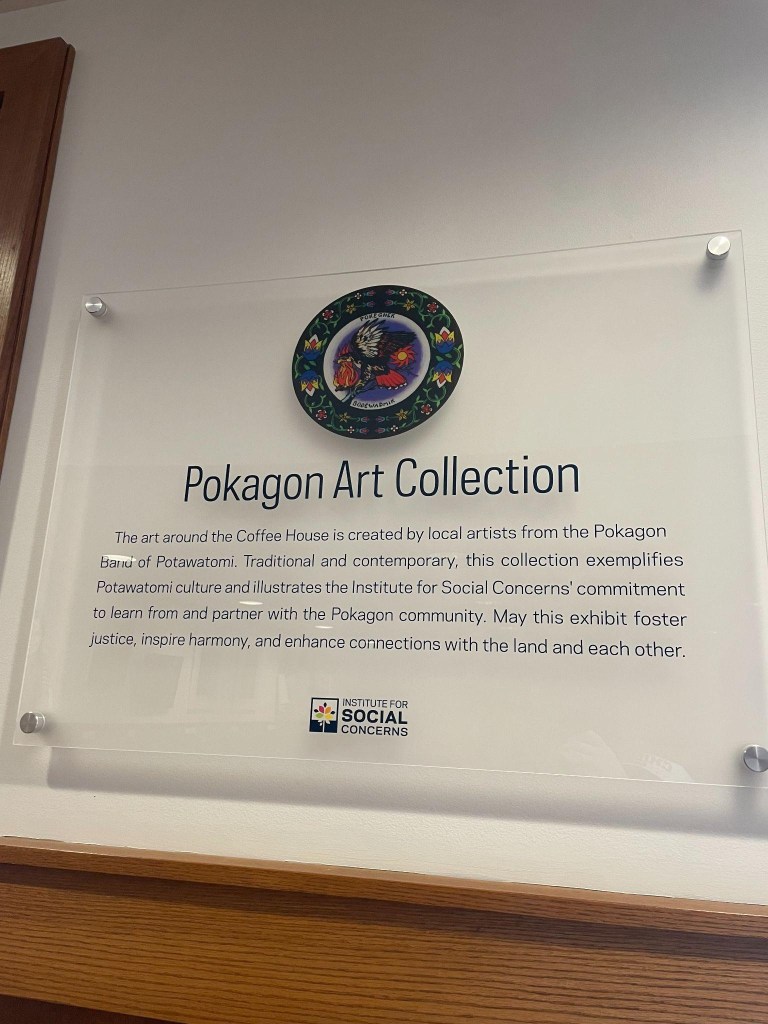
Figure 1. Pokagon Art Collection information card, coffee shop in Geddes Hall (Crossings), University of Notre Dame, March 2023. Photograph by author.
They continue by saying they hope the art can inspire harmony with the land and with one another. The Institute for Social Concerns website relays the importance of this exhibit as it “gives Pokagon artists an opportunity to show their art to non-natives” who may have never seen Indigenous art, and “it builds the positive bonds between the University of Notre Dame and the Pokagon Band of Potawatomi” (52). Although the academic discourse surrounding the Pokagon art exhibit has calmed down, casual inclusivity and representation is a phenomenal step in the right direction for the university. Providing the Notre Dame community with the opportunity to learn and explore other cultures in a casual environment is a significant development, as not all learning needs to occur in high-stakes situations. Expanding the conversation on Indigenous scholarship and representation on campus is always a positive step, and the university’s continued commitment to learning and positively representing the Pokagon and Indigenous communities is another step closer to reconciliation.
Raclin Murphy Museum Exhibit
On December 1, 2023, the Raclin Murphy Museum of Art, formerly the Snite Museum of Art, reopened to the public, accompanied by a new exhibit, “Indigenous Art of the Americas.” The exhibit features sections of North American, Central & South American, and Mesopotamian art. The North American Art section begins with a land acknowledgment, acknowledging their presence on Indigenous land, and presenting their commitment to “amplifying Indigenous voices and building conversation and collaboration through the hosting and support of Indigenous artists, art forms, and communities” (Figure 2).
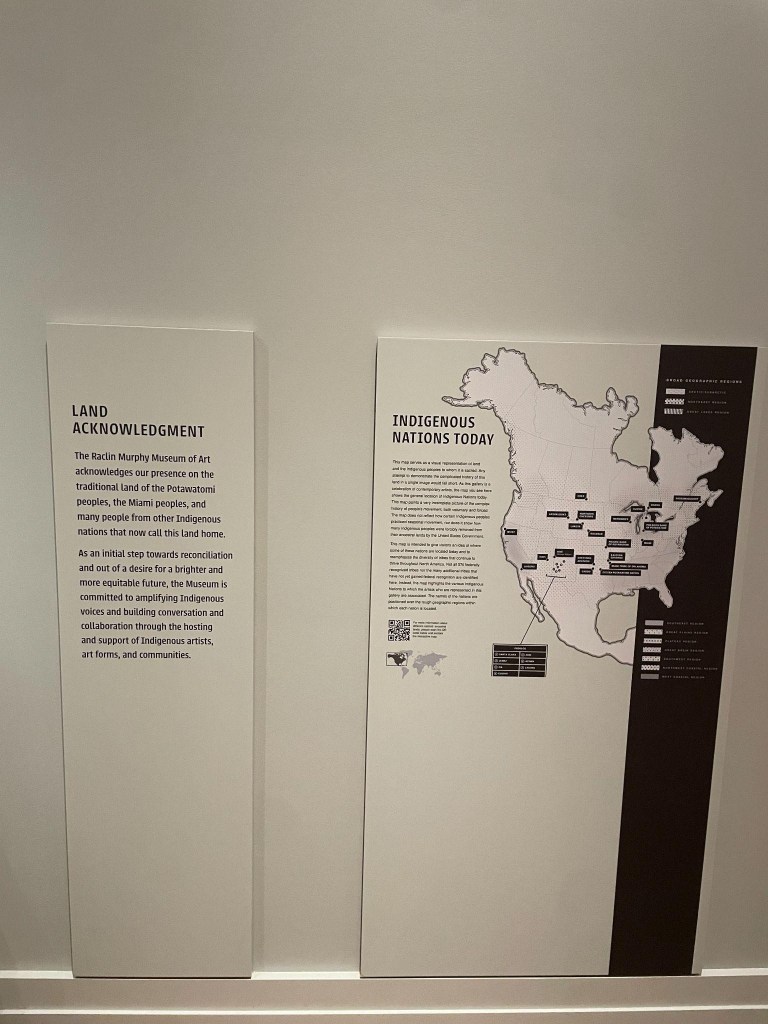
Figure 2. “Land Acknowledgment” panel and “Indigenous Nations Today” map, Indigenous Art of the Americas exhibition, Raclin Murphy Museum of Art (formerly the Snite Museum of Art), University of Notre Dame, December 1, 2023. Photograph by author.
Besides the land acknowledgement is an “Indigenous Nations Today” map, which includes text acknowledging that the map is very incomplete and that the history of movement has been both voluntary and forced. The art itself is plentiful in many forms, from basketry, pottery, ceramics, weaving, beading, painting, and much more. With the opening of the Raclin Murphy came a new viewpoint on exhibit curation. This time around, the Raclin Murphy wanted its visitors “to feel that this is their museum,” and that this ideology was at the core of each space created (53). To emphasize this goal, the museum features a neon “I belong here” sign. This viewpoint of curation is a beautiful one, as the goal is essentially inclusivity. The museum appears to be accomplishing this well, as it curates exhibits from Indigenous, African, Spanish, European, and other cultures. Once again, after passing the opening acknowledgements, the conversation surrounding the North American Indigenous art exhibit is low-stakes and exploratory. The ability for people to learn more about Indigenous history, culture, and art in one space is hugely important for Indigenous peoples to continue being part of the conversation on campus.
Simon Pokagon on Duncan Student Center
In 2018, as part of a Notre Dame Stadium renovation, the Duncan Student Center was opened on the west side of the stadium. The nine-story building is home to numerous academic departments, campus gyms, meeting rooms, and classrooms, and it serves as a central hub for students during the school year. With the opening of the new student center, the university commissioned Juan Sanchez for a large mural to be placed inside. The mural, “Prevalence: Sacred Traces,” was approved and finished in 2019, but it has garnered some controversy. Sanchez expressed that he wished to combine aspects of Notre Dame’s history with aspects of events in the United States through his mural, which he did by adding elements that could speak to people with differing cultural backgrounds. Sanchez added that the mural is “very politically loaded, politically layered…. It’s about colonialism. It’s about racism” (54). It appears that at the core of Sanchez’s hopes for the mural was to include people of all backgrounds in a single piece that both speaks out against injustices of our nation’s past and curates hope for the future. Despite the good intentions and hope to bring forth a piece that strikes up important conversations, the mural ended up garnering some controversy due to some elements not aligning with that of the Catholic tradition, such as the inclusion of LGBTQ+ elements. One of the subjects depicted in the center pillar of the mural is Chief Simon Pokagon, the same person depicted on the Rockne Memorial Building. This time around, Pokagon is depicted in his regularly-photographed attire, a suit and tie. Through my eyes, the mural’s central message is that everyone, regardless of background, is united as a human being worthy of God’s love. As Simon Pokagon is depicted here, things could be looking up for Indigenous peoples on Notre Dame’s campus, as it is clear that some are committed to remembering and showcasing Notre Dame’s history with the Pokagons.
Suggested Path of Reconciliation
Although the recent additions of positive Indigenous representation on campus have begun to counteract the negative representations seen from the late-19th century to the 1990s, they are not scratching the surface of what reconciliation would look like. For true reconciliation to be possible, the University of Notre Dame must show a genuine commitment to showcasing its shared history with the Pokagon Potawatomi and positively representing Indigenous peoples on its campus, built on historically dispossessed Pokagon land. A suggested first step towards striving for reconciliation would be to replace the Founder’s Plaque found near the Log Chapel.
Replacing the Founder’s Plaque is the best first move the university could possibly make. The Log Chapel and the Founder’s Plaque are staples for everyone who visits Notre Dame, with most students and staff having interacted with them as well. The Founder’s Plaque is one of the few monuments on campus that directly references the university’s founding, yet the contributions of Father Badin, Deseille, and Petit, as well as the Pokagons’ missionary works, are omitted from the plaque’s mention. Coming forward and replacing the Founder’s Plaque with a more complete version of Father Sorin’s letter to Father Moreau, one that includes the Indian mission and missionary works, would directly confront the university’s history of Indigenous erasure, showcasing a commitment to upholding the shared history between communities. Not only would this decision support the Pokagon and Indigenous communities, but it would also support the entire Notre Dame community, as the truth reveals the contextual background against which the university was built. The forthcoming truth would pay positive dividends between the university and the Pokagon band, as well as within the Notre Dame community, as the truth can help strengthen relationships.
Following the replacement of the Founder’s Plaque, the university should curate a permanent exhibit about Notre Dame’s founding and shared history with the Pokagon Potawatomi. The shared history between the Pokagon Potawatomi and the university, through Fathers Badin, Deseille, and Petit, is a critical piece of the past. One cannot be mentioned without the other, as each group plays an important role in the other’s history. Through these missionaries that are buried on Notre Dame’s campus, the Pokagon Potawatomi were able to escape the Trail of Death and continue living in their ancestral homeland. In contrast, Father Badin was brought to the region by his missionary duties, which gave him access to purchasing the land that later became the University of Notre Dame. This shared history should be important to all in the Notre Dame community because this place has changed everyone who has had the opportunity to touch it, which would not even be possible without Leopold Pokagon and the missionaries.
Following the curation of the museum exhibit, the university should incorporate the addition of Notre Dame’s founding and shared history with the Pokagon Potawatomi into the Moreau First-Year Seminar. Although the Museum exhibit would already convey all of this information, visiting a museum is a choice. Students at Notre Dame should be required to learn about the complete founding of the university in the Moreau First-Year Seminar that every first-year student must take. Requiring students to learn this information would demonstrate the university’s commitment to confronting its history of Indigenous erasure, as well as provide each student with a comprehensive understanding of how Notre Dame became the institution it is today.
Following the addition of Notre Dame’s founding and shared history with the Pokagon Potawatomi to the Moreau First-Year seminar, the final and most important step towards reconciliation would be the installation of a permanent plaque and a corresponding gift to the Pokagon Potawatomi. In an ultimate attempt to right the wrongs of the university’s history of Indigenous erasure, the rectification of a new plaque featuring Chiefs Leopold and Simon Pokagon arm-in-arm with Fathers Badin, Deseille, and Petit would solidify the University of Notre Dame’s commitment to honoring and showcasing its shared history with the Pokagons.
As seen in Figure 3 below, the new plaque would be placed alongside the replaced Founder’s Plaque, and together they will offer a genuine look into the history of Notre Dame’s founding. This plaque will be printed in a set of two, for the university to offer one to the Pokagon Band of the Potawatomi as a gift, an apology for the erasure of their history from ours, and as a token of commitment to upholding a lasting friendship through collaboration.
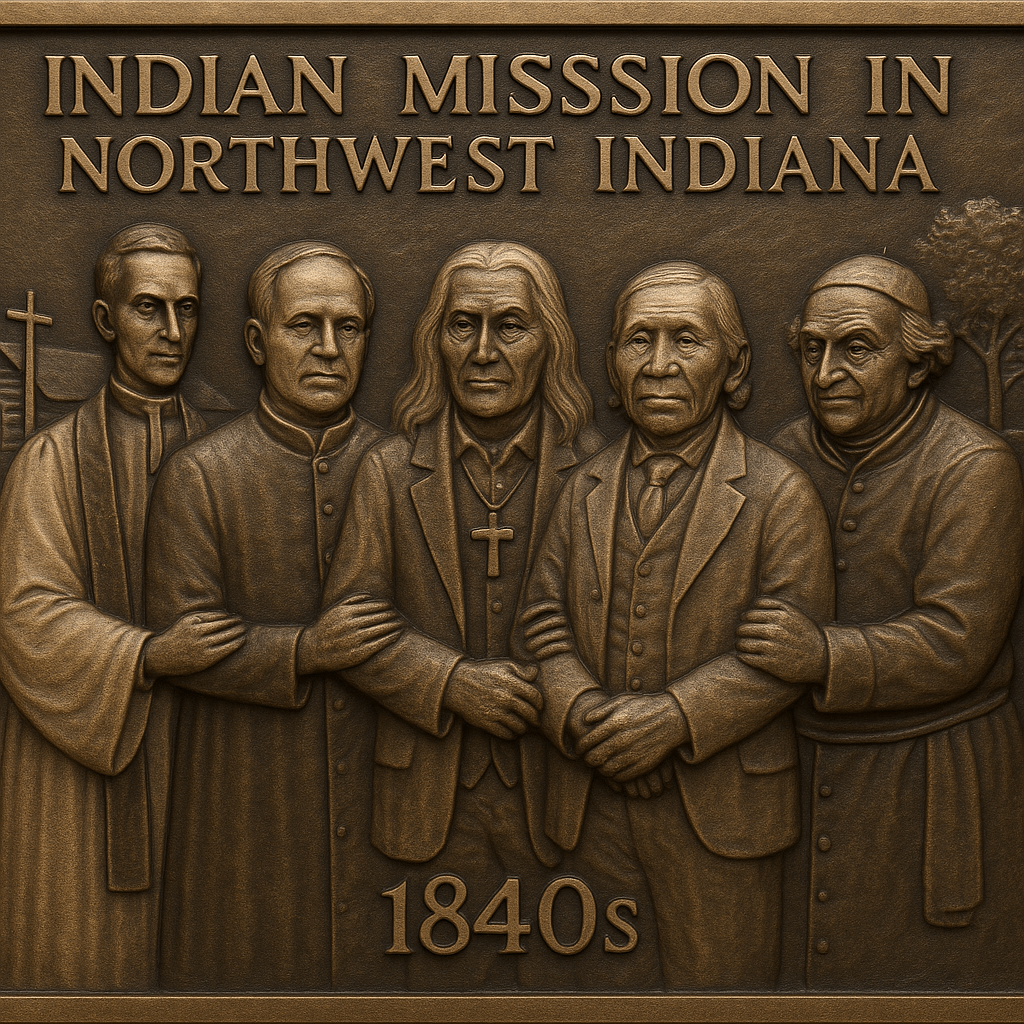
Figure 3. Concept rendering of proposed “arm-in-arm” plaque depicting Chiefs Leopold and Simon Pokagon with Fathers Stephen Badin, Louis Deseille, and Francis Xavier Petit, intended for installation alongside the University of Notre Dame Founder’s Plaque. Digital mockup created by author, 2025 (55).
Conclusion
The University of Notre Dame was founded on November 26, 1842, by Father Edward Sorin and a group of brothers seeking to establish a great university in the heart of America. The land which they acquired from the Bishop of Vincennes was gifted by Father Badin following his missionary times at the premises. Father Badin, who came to the area to serve as a missionary to the Pokagon Potawatomi, was able to acquire the land from private owners and the government, as it had previously been ceded to the United States through forced treaties.
Unfortunately, this history is largely unknown within the Notre Dame community because of the university’s history of Indigenous erasure in favor of Columbianist ideals. Beginning in 1881 and lasting through the 1990s, the university participated in Indigenous erasure through its artistic and monumental works, including the Luigi Gregori Christopher Columbus Murals, the Knute Rockne Memorial Building, and the Founder’s Plaque. The first two instances of erasure occur in the presentation of Colombianist ideals with the hopes of inspiring Catholic Americans during a time of heavy anti-Catholic prejudice, but did so by marginalizing Indigenous communities through stereotypical imagery and harmful depictions of the beginning of Indigenous disenfranchisement in the United States.
In 2019, however, things began to shift with the announcement that the Christopher Columbus murals in the main building would be covered with Pokagon-designed tapestries. Following this announcement and change, positive representations of Indigenous people began appearing across campus, including the Pokagon Art collection in the Geddes Hall coffee shop, the Raclin Murphy Indigenous North American Art exhibit, and the Prevalence mural in the Duncan Student Center. It is great to see that the conversation has shifted to ways to support, incorporate, and positively represent Indigenous peoples at Notre Dame, but these developments do not accomplish enough to achieve reconciliation within the university community or with the Pokagon Potawatomi. There are endless ways the university could approach reaching reconciliation of its history of Indigenous erasure, with one plan including replacing the Founder’s Plaque, adding a new exhibit about the university’s founding and shared history with the Pokagon, implementation of that information into the Moreau First-Year seminar, and finally a new arm-in-arm-style permanent plaque and corresponding gift to the Potawatomi showcasing Fathers Badin, Deseille, and Petit alongside Chiefs Leopold and Simon Pokagon.
Jason Wesaw is a Pokagon artist who was featured in both the Geddes Hall coffee shop art collection and the Raclin Murphy Indigenous North American Art collection. Below a piece of his art in the Raclin Murphy exhibit, as seen in Figure 4, Wesaw writes:
“Our life as Potawatomi people and the nurturing connection we maintain to the land and to the spirits of this place are ancient and unbroken. We must always be conscious of these relationships and how they arrange us amongst all of Creation.”
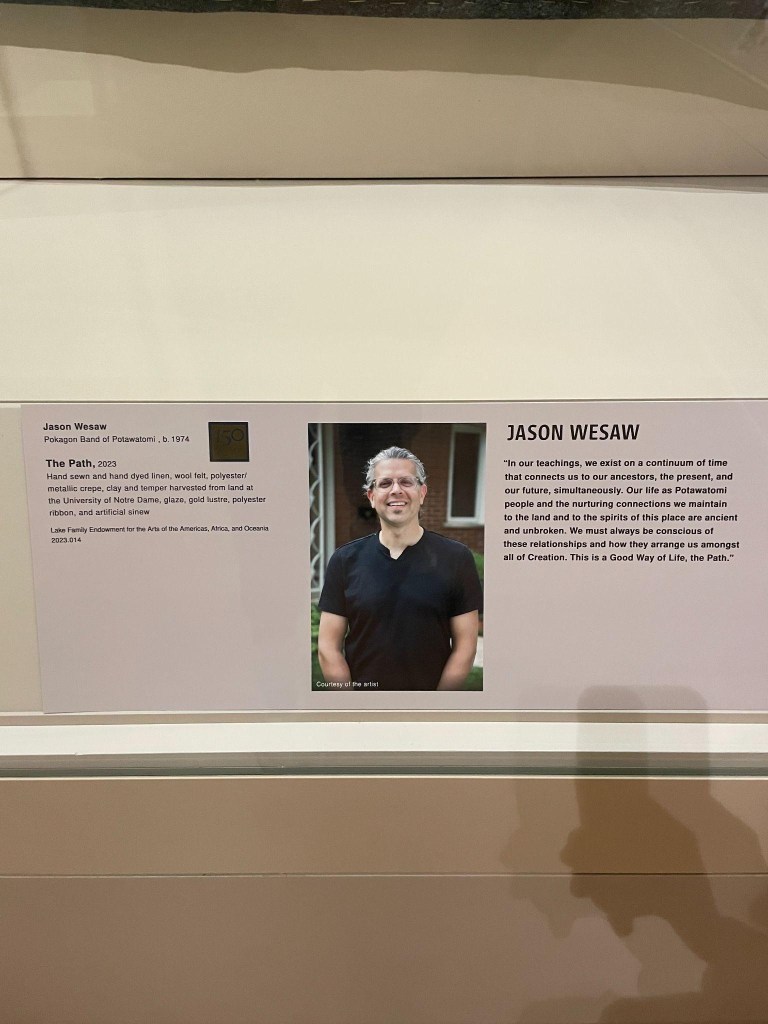
Figure 4. Exhibition label for Jason Wesaw (Pokagon Band of Potawatomi, b. 1974), The Path, shown in the “Indigenous Art of the Americas” exhibition, Raclin Murphy Museum of Art, University of Notre Dame, December 2023. Photograph by author.
Here, Wesaw is saying everything I wish from this project, and everything I wish for the Notre Dame community. We must always be conscious of our relationships (as individuals and as members of the Notre Dame community) and how they position us within all of Creation. One of the earliest relationships for Notre Dame is between the Pokagon Potawatomi, whom we should always be mindful of, as they helped pave the way for Notre Dame. In order for the University of Notre Dame to truly become a great Catholic American university and reconcile its history of Indigenous erasure, it must commit itself to accurately and positively representing the inhabitants of the land before, the Pokagon Potawatomis, and all American Indigenous nations on its campus, because how can anyone feel safe and at home if Indigenous students feel marginalized on a campus built on historically Indigenous land?
Austin Harjo is a marketing and American studies major. His essay was originally written for Professor Kathleen Sprows Cummings’ American studies course “Notre Dame and America.”
References
- Clifton, James A. The Pokagons, 1683–1983: Catholic Potawatomi Indians of the St. Joseph River Valley. Lanham, MD: University Press of America, 1984, 38.
- Clifton, The Pokagons, 36.
- Clifton, The Pokagons, 39.
- Clifton, The Pokagons, 39.
- Clifton, The Pokagons, 38.
- Leeper, David Rohrer. Some Early Local Footprints: The Pokagon Village: The Notre Dame Lakes: Our Savage Predecessors. South Bend, IN: [publisher not identified], 1898, 1.
- Hope, Arthur J. Notre Dame: One Hundred Years. Notre Dame, IN: University Press, 1943, 38.
- Hope, Notre Dame, 38.
- Clifton, The Pokagons, 40.
- Clifton, The Pokagons, 40.
- Clifton, The Pokagons, 40.
- Clifton, The Pokagons, 45.
- Clifton, The Pokagons, 44.
- Clifton, The Pokagons, 48.
- Blantz, Thomas E. The University of Notre Dame: A History. Notre Dame, IN: University of Notre Dame Press, 2020, 27.
- Blantz, University of Notre Dame, 27.
- Leeper, Some Early Local Footprints, 5.
- Blantz, University of Notre Dame, 27.
- Blantz, University of Notre Dame, 27.
- Blantz, University of Notre Dame, 28.
- Blantz, University of Notre Dame, 30.
- Blantz, University of Notre Dame, 26.
- Blantz, University of Notre Dame, 26.
- Meyers, Sophia. Artist in Residence: Working Drawings by Luigi Gregori (1819–1896): The Snite Museum of Art, January 15–March 11, 2012. Notre Dame, IN: Snite Museum of Art, University of Notre Dame, 2011, 8.
- Meyers, Artist in Residence, 15.
- Meyers, Artist in Residence, 19.
- Meyers, Artist in Residence, 17.
- Holslag, Frank William. “Paintings at the University of Notre Dame.” Fine Arts Journal 35 (1917): 13. https://www.jstor.org/stable/25587434.
- Lindquist, Sherry C. M. “Memorializing Knute Rockne at the University of Notre Dame: Collegiate Gothic Architecture and Institutional Identity.” Winterthur Portfolio 46, no. 1 (2012): 9. https://doi.org/10.1086/665045.
- Lindquist, “Memorializing Knute Rockne,” 9.
- Holslag, “Paintings at the University of Notre Dame,” 17.
- Holslag, “Paintings at the University of Notre Dame,” 17.
- Holslag, “Paintings at the University of Notre Dame,” 18.
- Holslag, “Paintings at the University of Notre Dame,” 19.
- Lindquist, “Memorializing Knute Rockne,” 8.
- Lindquist, “Memorializing Knute Rockne,” 8.
- Lindquist, “Memorializing Knute Rockne,” 23.
- Lindquist, “Memorializing Knute Rockne,” 8.
- Lindquist, “Memorializing Knute Rockne,” 13.
- Lindquist, “Memorializing Knute Rockne,” 13.
- Lindquist, “Memorializing Knute Rockne,” 13.
- Lindquist, “Memorializing Knute Rockne,” 13.
- Lindquist, “Memorializing Knute Rockne,” 13.
- Lindquist, “Memorializing Knute Rockne,” 13.
- Lindquist, “Memorializing Knute Rockne,” 14.
- Lindquist, “Memorializing Knute Rockne,” 8.
- Lindquist, “Memorializing Knute Rockne,” 15.
- Moreau, Basile-Antoine-Marie. Circular Letters of the Very Reverend Basil Antony Mary Moreau: Founder and First Superior General of the Congregation of Holy Cross. Translated by James W. Donahue. Notre Dame, IN: Congregation of Holy Cross, Office of the Superior General, 1932, 259. Notre Dame Archives.
- Moreau, Circular Letters, 259.
- Copeland, Shelby. “University of Notre Dame to Cover Christopher Columbus Murals.” CNN, January 23, 2019. https://www.cnn.com/style/article/university-of-notre-dame-christopher-columbus-murals-trnd-style.
- “Columbus Murals Covered.” Notre Dame Magazine, Autumn 2020. https://magazine.nd.edu/stories/columbus-murals-covered/magazine.nd.edu.
- Institute for Social Concerns. “Pokagon Art Collection Opens with Celebration and Collaboration.” March 16, 2023. https://socialconcerns.nd.edu/news/pokagon-art-collection-opens-with-celebration-and-collaboration/.
- University of Notre Dame, Public Affairs. “You Belong Here: Raclin Murphy Museum of Art Opens to the Public.” December 1, 2023. https://publicaffairs.nd.edu/news/you-belong-here-raclin-murphy-museum-of-art-opens-december-1/.
- Whitaker, James, and Haley Garecht. “Rover Interviews Artist Behind Controversial Mural.” Irish Rover, November 20, 2024. https://irishrover.net/2024/11/rover-interviews-artist-behind-controversial-mural/.
- OpenAI. Bronze bas-relief plaque draft depicting five historical figures arm in arm, based on five user-supplied historical images. Image generated by ChatGPT (DALL·E), December 2025.

